The Most Colourful Public Art Installations Perched At The Edge Of The World
A compelling mix of colour, material, and context, these installations invite you to step inside art itself, turning fleeting encounters into memorable, multisensory experiences across diverse global landscapes.
- 14 May '26
- 4:56 pm by Aditi Singla

|
Getting your Trinity Audio player ready...
|
A new wave of designers and artists is reimagining public art installations through unapologetic expressions of colour and form, extending their interventions far beyond cities into remote and unexpected landscapes. At once interactive and deeply atmospheric, these works transform diverse geographies into sites of pause and play, encouraging a public experience unfolding over time and in dialogue with place. Do we need them? Increasingly, the answer feels like a resounding yes. More than a visual spectacle, they foster connections among people and places, between strangers, and even within oneself, offering moments of joy, curiosity, and sensory immersion. Design Pataki curates three stunning installations that bring colour, tactility, and meaning into the landscapes and environments we commute or travel to.
Also read: Navigating Milan Design Week 2026: 3 Design Collabs You Can’t Scroll Past
1. STRIP TOWER (962) by Gerhard Richter | Switzerland
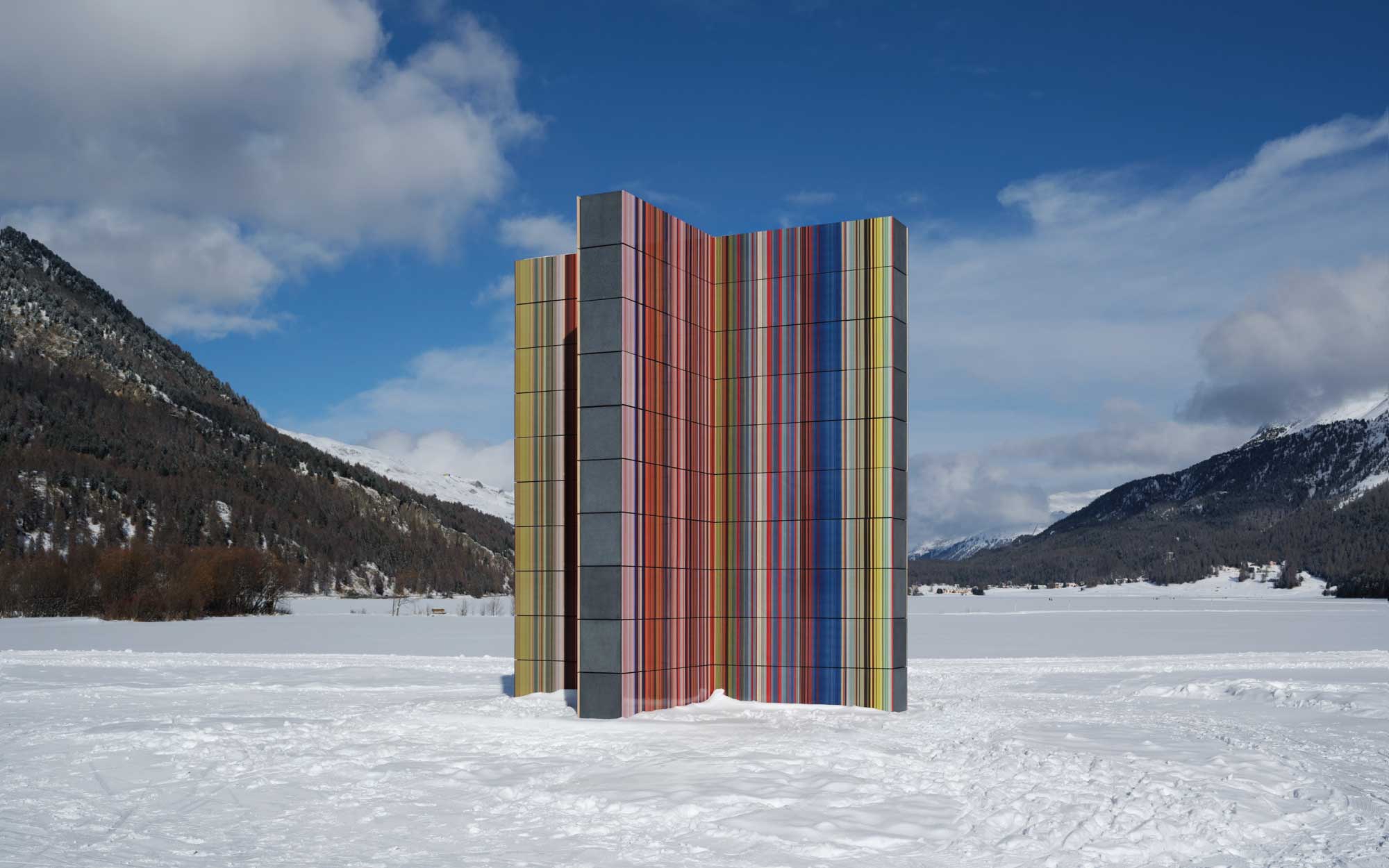
Set against the crystalline expanse of Lake Silvaplana in Sils Maria, Switzerland, STRIP TOWER (962), 2023 by Gerhard Richter emerges as a compelling long-term public installation that redefines the dialogue between art and landscape. Presented by the Luma Foundation from 27 January 2026, as part of Elevation 1049, the installation extends the project’s geographical and conceptual reach into one of Switzerland’s most historically resonant and environmentally distinctive Alpine landscapes. The installation will remain on view for three years.
Rising over five metres, the work is composed of eight perpendicular panels clad in glazed ceramic tiles, each carrying elongated vertical bands of colour. These bands stem from Richter’s ongoing Strip Paintings, where a single gesture is reworked through photography, scanning, and digital manipulation into a layered chromatic language. Here, that process steps off the canvas and into space, allowing colour and repetition to unfold architecturally. The glossy façade responds dynamically to shifting light, weather, and seasonal change, while the cross-shaped interior formed at the intersection of the panels invites visitors to step inside for an immersive spatial encounter. Here, that methodology is propelled into three dimensions, allowing colour, repetition, and perception to occupy space rather than surface. The glossy façade responds dynamically to shifting light, weather, and seasonal change, while the cross-shaped interior formed at the intersection of the panels invites visitors to step inside, transforming passive viewing into an immersive spatial encounter.
Also read: Why The Mark Hotel In NYC Has Become The Met Gala’s Go-To Dressing Room
2. ‘A Forest of Delight’ by Adam Nathaniel Furman | Japan
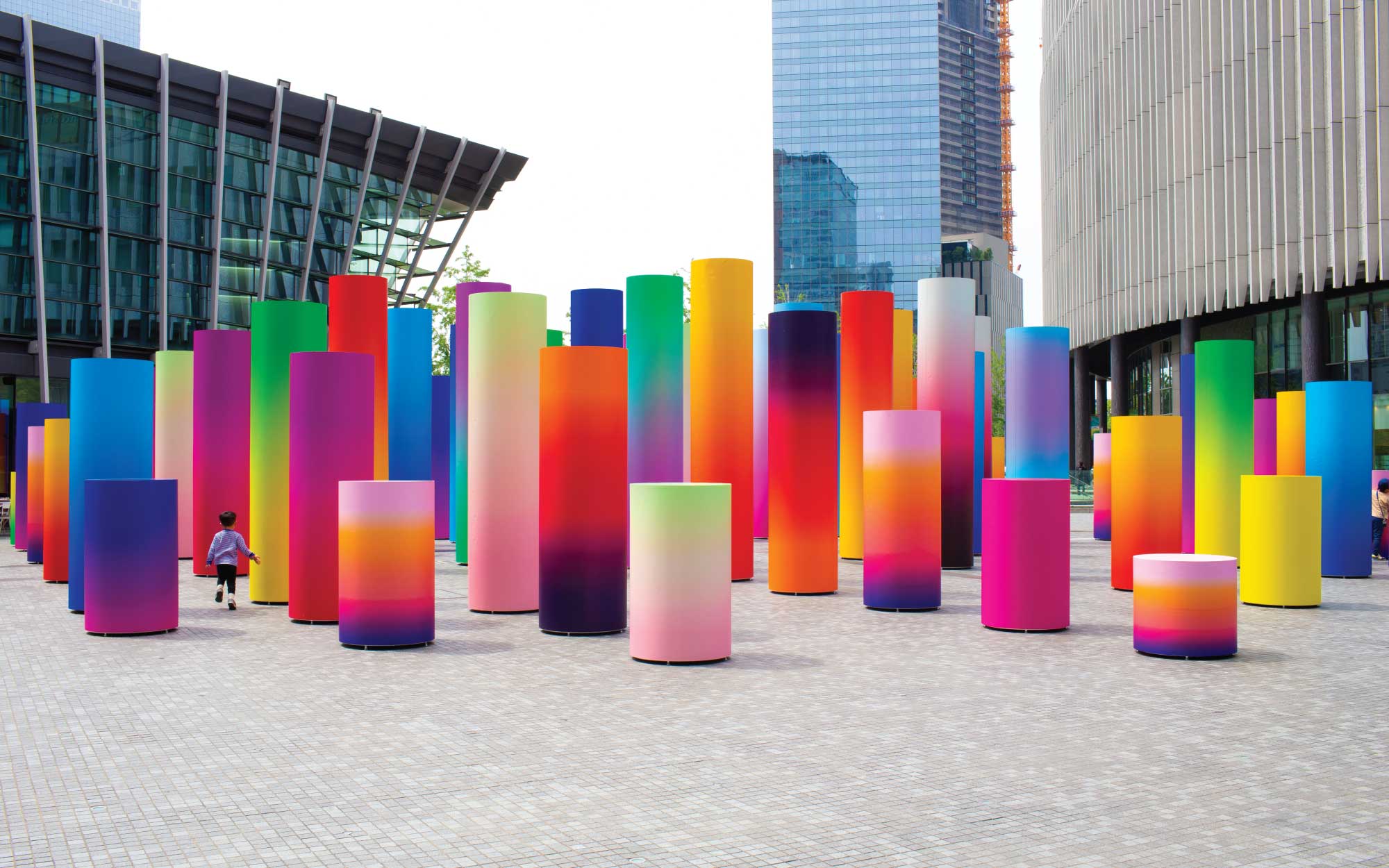
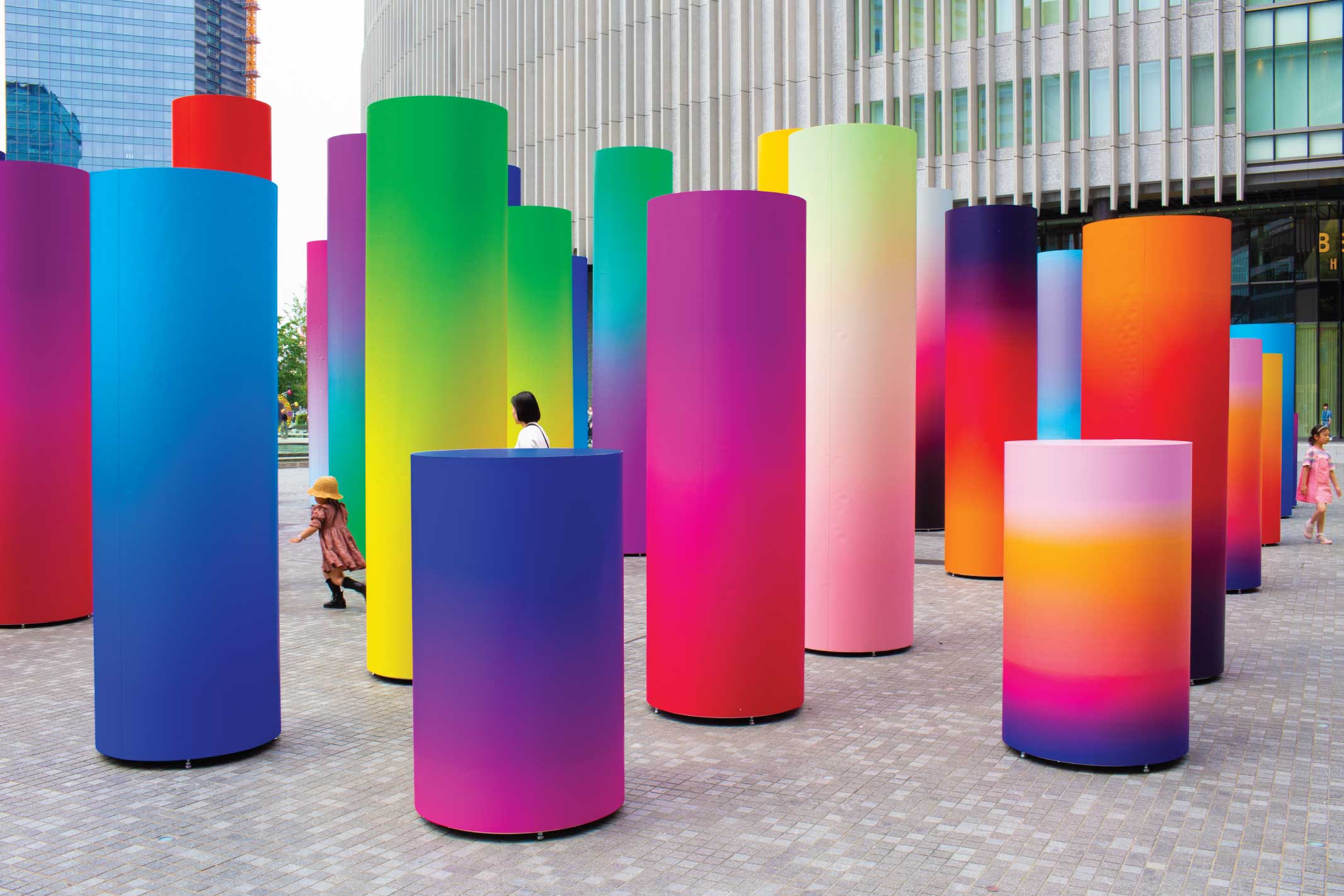
At Umekita Plaza, just outside the ever-thronged Osaka Station, Adam Nathaniel Furman’s ‘A Forest of Delight’ punctuates the urban rush with an arresting burst of chromatic exuberance. Commissioned by Osaka Art & Design in collaboration with Mitsubishi Estate, the installation transforms a quotidian transit plaza into an immersive field of cylindrical columns, their varying heights and saturated gradients conjuring a surreal, almost floral topography. What reads at first glance as a playful arrangement of forms reveals a more nuanced urban intervention, one that interrupts the greyscale monotony of steel and concrete with a momentary, almost cinematic escape. For the millions who traverse this precinct daily, the work serves as both a visual respite and a spatial theatre, inviting passersby to meander, pause, and—if only fleetingly—inhabit a landscape of uninhibited colour and quiet wonder.
Also read: #DP Exclusive: Modernising ‘Nani Ka Ghar’: A Traditional Courtyard Anchors This Ahmedabad Apartment
3. ‘From Desert Sand to Alpine Snow’ by Milla Novo | Alpine region
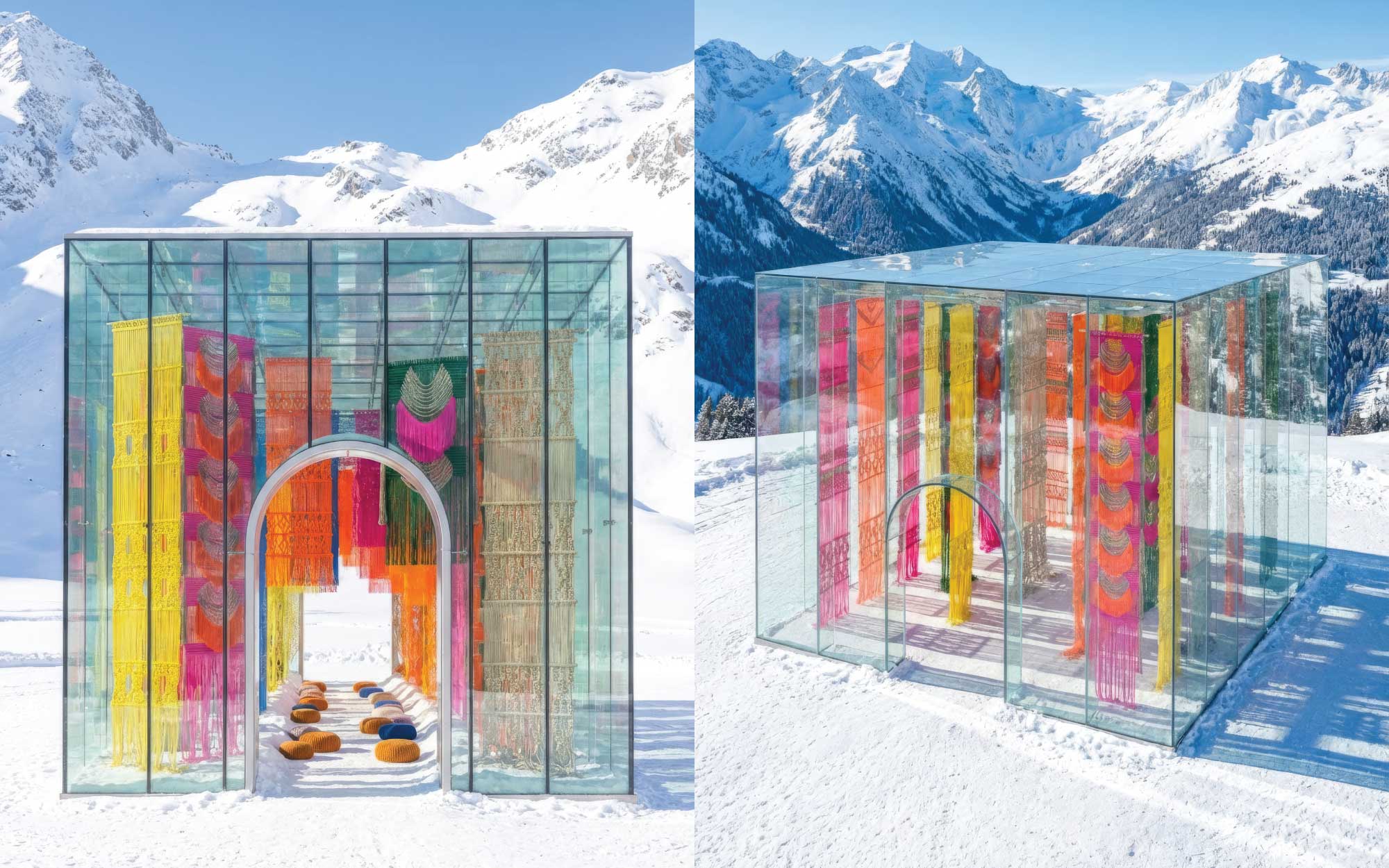
Set against a vast alpine expanse, ‘From Desert Sand to Alpine Snow’ by Dutch-Chilean fiber artist and installation designer Milla Novo reimagines the possibilities of textile art within extreme geographies. Conceived after her immersive installation in the Mleiha Desert for the Tanweer Festival: an initiative founded by Sheikha Bodour Al Qasimi, the project pivots dramatically from arid warmth to glacial stillness. Encased within a crystalline glass pavilion, a sequence of monumental hand-knotted macramé panels cascades from ceiling to floor, saturating the stark whiteness of snow with an arresting spectrum of colour and tactility. The glass structure itself operates as both a vitrine and a threshold, its transparency dissolving the boundary between the interior and the landscape beyond. As visitors pass through the arched entry into a corridor of layered fibres, the installation unfolds as a study in contrast, where ancient craft meets architectural clarity, and where colour and tactility momentarily transform the stillness of snow into an immersive spatial encounter.