Artist Jayasri Burman’s Jewellery Collection Is A Sculptural Exploration Of Indian Mythology
From mythological women and the natural world to sculptural jewellery, Jayasri Burman reflects on the stories, emotions and spiritual impulses that shape her artistic imagination.
- 27 Nov '26
- 3:23 pm by Sana Krishna

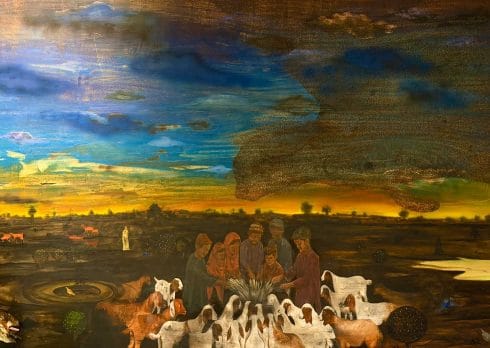
Over the decades, Jayasri Burman has developed a distinctive visual language informed by Indian mythology, folk traditions and the natural world. Trained at Kala Bhavana, Santiniketan, and the Government College of Art and Craft, Kolkata, she works across watercolour, pen and ink, acrylic, oil and mixed media, extending her practice from painting into sculpture. Her compositions bring together women, goddesses, animals and fantastical beings, drawing on the visual vocabularies of Kalighat and Patachitra while exploring the relationship between the earthly and the divine. A recipient of the National Award in 1985, Burman has exhibited widely in India and internationally, and her work was also commemorated in a series of postage stamps released by the Government of India in 2007.
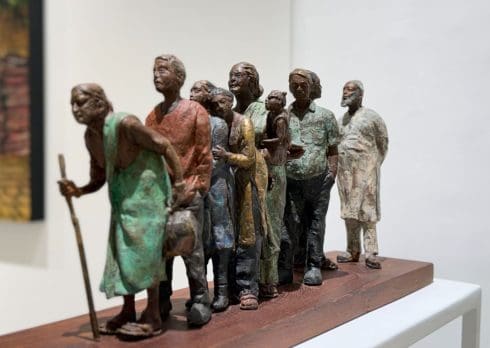
With Mukti, Burman revisits the stories of Nandini, Chandalika, Behula and Bonobibi, examining feminine strength, identity and transformation through these culturally resonant figures. Alongside it is ‘Amlaan,’ her first jewellery collection, conceived over a decade ago and developed through an extended collaboration with Jaipur’s traditional artisans. Translating the sculptural sensibility of her paintings into wearable forms, the collection brings together precious metals, gemstones and the knowledge of generations of craftspeople. Though distinct in medium, both projects are rooted in bhaav — the emotional and spiritual impulse at the heart of creation. In this conversation, Burman reflects on the divine feminine, our estrangement from the natural world, the relationship between painting and jewellery, the knowledge of artisans, and the stories that continue to shape her imagination.
Design Pataki: In Indian iconography, the divine feminine is defined by adornment and visual abundance. Do you question this inherited imagery? What might a goddess look like without it?
Jayasri Burman: I do think about this, and in this series, the work ‘Krishnakali’ is presented without the familiar abundance of adornment. Power does not necessarily come from what a woman wears; it resides within her, in her eyes, her spirit and the strength of her presence. I remember my painting of ‘Bishwanath Gali,’ which came from an experience in Banaras, when I saw a voluptuous woman selling Shivlings in the narrow lanes. There was something so powerful and self-assured about her that she immediately reminded me of Parvati. I realised that the divine can reveal itself in the most ordinary human presence, without ornamentation or ceremony.
DP: Your imagery inhabits an enchanted world where the human, animal, botanical and divine coexist. Is this an act of imagination, a response to the world as it exists, or a longing to recover our lost connection with nature?
JB: I think it is a world that comes naturally to me, shaped by the stories I have heard, the places I have lived in and the experiences I have gathered over the years. I have never felt that imagination needs to be separate from reality; sometimes it allows us to see reality more deeply. The stories and traditions I grew up with recognised rivers, trees, animals and even the elements as having their own identities and sacred significance. Our mythology was never confined to gods and goddesses; it was deeply connected to geography, climate and everyday life. I think we have gradually distanced ourselves from nature, seeing ourselves as separate from it rather than part of it. Through my paintings, I bring the familiar and the imagined together, hoping to recover that sense of wonder and coexistence, where every living being has a place and a presence.

DP: If you were to remove every recognisable mythological reference from your work, what do you think would remain that is unmistakably ‘Jayasri Burman’?
JB: I think what would remain is bhaav — the emotion that lies at the heart of everything I create. Mythology, literature, folklore and memory are different layers of storytelling that come together in my paintings, but the emotion is always the starting point. It is what gives life to a figure, whether it is a goddess, a woman, an animal or an imagined being. Even without recognisable references, I hope there would still be a certain energy and spiritual presence that people associate with my work.

DP: Do you think there are certain things that painting allows you to express, what jewellery could not?
JB: Every medium has its own language and possibilities. Painting allows me to create an entire world, bringing together landscapes, figures, stories and emotions on a single surface. Jewellery is much more intimate and demands a different kind of thought because it is experienced on the body. There are things I can express on canvas that would not translate directly into jewellery, and I have learnt to respect those differences. I don’t see one medium as limiting the other; each allows me to discover a different dimension of the same artistic language.

DP: What first drew you to jewellery as a medium of artistic expression, rather than, say, clothing?
JB: My interest came from my love of sculpture and the possibility of translating my forms into something that could be worn close to the body. Jewellery offered a fascinating meeting point between sculpture, material and craftsmanship. I was drawn to the idea that an artwork need not always occupy a wall or a space; it could become something personal, almost like a small sculpture that travels with its wearer. Clothing has its own possibilities, but jewellery felt much closer to the sculptural language I had been exploring for years.

DP: You have presented ’Mukti’ alongside ‘Amlaan’. Was ’Amlaan’ conceived in response to ’Mukti,’ or did the two projects develop independently before finding a point of connection?
JB: The two projects developed independently, although they come from the same artistic journey. ’Amlaan’ had been taking shape through my experiments with jewellery for almost a decade, while ’Mukti’ brings together a body of paintings and sculptures rooted in mythology, literature, nature and the feminine imagination. As the projects evolved, I began to recognise a natural connection between them. Both are expressions of my relationship with stories, forms and the world around me, but each offers a different way of experiencing that language. Bringing them together felt like allowing two parts of my practice to enter into a conversation.
DP: What was the first piece you imagined for ‘Amlaan,’ and what kept drawing you back to the idea until it became a collection?
JB: It began with curiosity rather than a clearly defined idea of creating a collection. I was interested in seeing how the sculptural forms that existed in my paintings could be translated into jewellery, and I began experimenting with different materials and shapes. Each piece opened up another question and encouraged me to explore further. I kept returning to the medium because there was always something new to discover, whether in the material, the process or the collaboration with artisans. Over time, these experiments developed into a body of work that felt ready to be shared.

DP: What drew you to visuals of women, and how do you approach the challenge of bringing their histories into conversation with the present without diminishing their complexity?
JB: I have always been drawn to women whose stories carry layers of strength, vulnerability, resistance and transformation. These figures come from very different worlds, but each of them raises questions that continue to be relevant today. Nandini, Chandalika, Behula and Bonobibi are not simply characters from literature or folklore; they embody experiences and struggles that speak across generations. I approach them with great respect for the stories they come from, researching their histories and trying to understand the world that shaped them. My intention is not to retell these narratives in a literal way, but to find an emotional and visual connection through which they can speak to our present.
DP: Gold occupies a central place in Amlaan. What is it about gold that makes it such a natural extension of your visual language? Has working with this precious material altered your understanding of colour, form and permanence, and why did you choose 18-carat gold rather than 22-carat?
JB: Gold has always fascinated me for its purity and ability to hold light. The Indian yellow that often appears in my paintings has a certain richness and energy, and I find a similar quality in gold. Working with it has made me more conscious of how light interacts with form and how a material can transform the way we experience an object. We chose 18-carat gold because it offered the right balance of richness, strength and practicality for the sculptural forms I wanted to create, and for the gemstones to set. It allowed us to explore the intricacies of the designs while retaining the preciousness and character gold brings to the collection.

DP: You have worked closely with artisans to translate your paintings and sculptures into jewellery. How has this collaboration shaped Amlaan? Were there moments when the craftspeople’s knowledge challenged your original vision or led you towards an unexpected form?
JB: The collaboration with artisans has been one of the most important parts of this journey. I came with an artistic vision, but translating that vision into jewellery required an understanding of structure and technique. The artisans brought years of experience and a knowledge that I could not have acquired on my own. There were many instances when a form had to be reconsidered or approached differently because of the technical demands of the medium. Rather than seeing these as limitations, I found them to be opportunities for discovery. The final pieces carry both my artistic imagination and the extraordinary skill of the people who helped bring them to life.
DP: You describe your studio as a space of sadhana. What does this daily practice look like for you? How do you make room for uncertainty, doubt or even failure within a practice so deeply connected to faith and the search for harmony?
JB: Sadhana is the discipline of returning to my work every day with sincerity and openness. It is not always a peaceful or certain process; there are moments of doubt, frustration and days when nothing seems to come together. I have learnt that these moments are also part of making art, and that one must allow oneself the freedom to experiment and sometimes fail. My relationship with painting is engaging and spiritual, but that does not mean I always know where a work is going. Often, the most meaningful discoveries happen when I allow the process to lead me somewhere unexpected.

DP: What have Mukti and Amlaan revealed about the possibilities of your practice? Are there stories or figures you have yet to explore?
JB: Working across painting, sculpture and jewellery has allowed me to approach familiar ideas from new perspectives, with each medium revealing possibilities I might not otherwise have discovered. I feel there is still so much to explore: stories, women, mythological figures and aspects of our cultural memory. I hope to continue with the same curiosity, allowing each new journey to find its own direction.