Ceiling The Deal: 5 Homes Reinventing The Fifth Wall With Frescoes, Coffers, Cane And Clay
From a William Morris-inspired botanical mural to a crimson coffered pooja room and a patterned brick slab, these five Indian homes treat the ceiling as a surface for storytelling.
- 6 Oct '26
- 5:45 pm by SHIVANI VK

Inventiveness is a key ingredient to good design. It means looking at something ordinary and seeing instead what it could be. And why limit this thinking to the usual suspects, the four walls of a room? Design Pataki looks at 5 homes that take inventiveness upward, to the ceiling.
Using the ceiling as a surface for expression is far from novel; take the classic example of Michelangelo’s Sistine Chapel in Vatican City, or the mirrored Sheesh Mahals of Rajasthan or the ornate woodwork in the Palaces of South India. But somewhere along the way, the white ceiling became the norm in contemporary homes, with walls, furnishings and flooring doing the heavy-lifting of bringing character into spaces. These homes see things differently, with the ceiling being an anchoring element and an integral part of the design narrative.
Also Read: #DP Trends: Colour Drenching Marks The Bold Departure Of Neutrals
1. A Gilded Botanical Ceiling by Beyond Designs
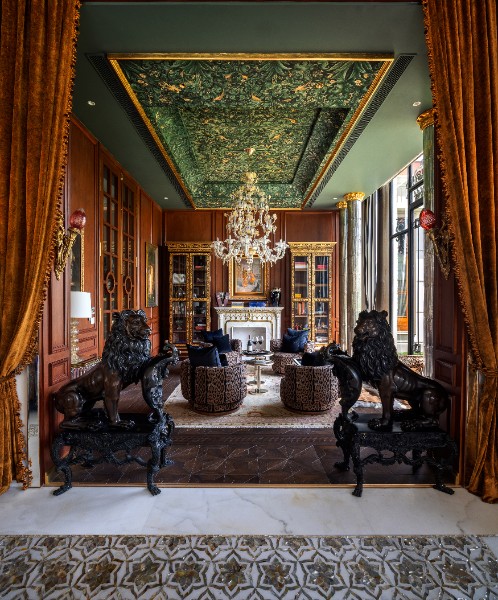
The Cognac Bar at Third Avenue Residence, a New Delhi home by Beyond Designs, is an intimate setting layered with heritage-inspired details. Warm wood panelling, classic parquet flooring, hand-painted book units, and a collection of art and artefacts create a richly detailed interior. Yet, it is the ceiling that brings the composition together.“We wanted the space to feel enveloping and unapologetically maximalist, with craftsmanship extending from the walls and furniture right through to the ceiling,” says Sachin Gupta, Founder and Principal Designer at Beyond Designs.
Hand-painted on wood using vegetable dyes and finished with deep green and gold leaf, the mural takes its cues from the botanical tapestries of William Morris, with a chandelier at its centre that brings the motifs into focus. “The hand-painted surface brings an element of individuality and artistry that a printed finish cannot replicate. It makes the ceiling feel almost like a piece of art suspended above the room,” he explains.
2. A Painted Travel Diary by MuseLAB
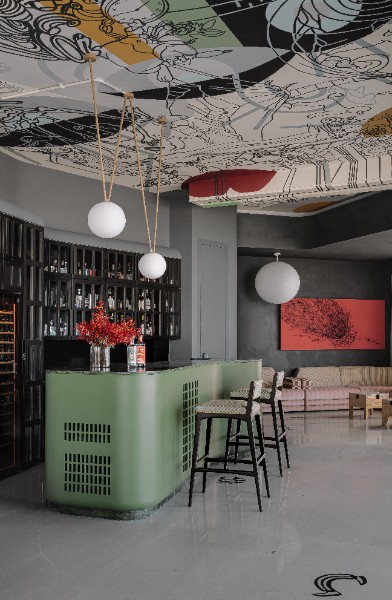
While a painted ceiling can take notes from traditional ornamentation, it can also become a canvas for a more personal expression, as in Maison Zoe, a Mumbai apartment by MuseLAB. The team commissioned House of Berserk to create a contemporary fresco, bringing together moments from the homeowners’ lives and travels in a sprawling illustration above the living space, marked by bold black lines and dollops of colour.
On choosing the medium, Jasem Pirani, Director, MuseLAB, says, “The pPainting allowed us to introduce colour and details while keeping it physically simple. It also gave us a way to bring in personal references through illustration.” Motifs from the artwork reappear in parts of the flooring, while solid-coloured furniture and accents bring the palette together, creating a cohesive environment. “We tend to forget about the ceiling. Most of the time it becomes a surface for lights, air conditioning and services, but it can do so much more,” he adds. “At Maison Zoe, it became another plane where the story of the home could live.”
3. A Crimson Coffered Ceiling by Temple Town
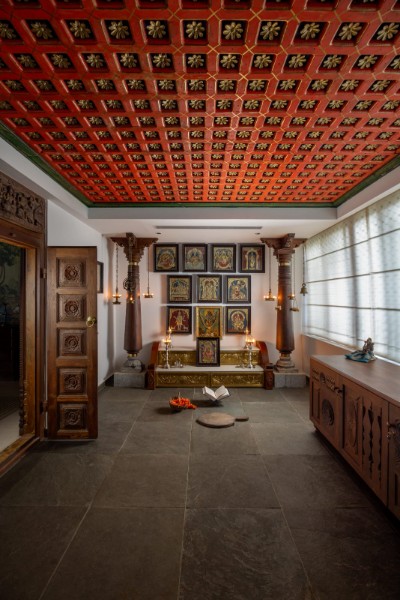
At Coromandel Court, a Bengaluru residence by architecture studio Temple Town, the pooja room’s ceiling draws from the traditional architecture of South India. Recycled wood coffers, lacquered in crimson, lend depth and grandeur to the sacred space. Hand-painted golden flowers sit within each recessed panel, and repeated across the grid, they turn the ceiling into a single continuous pattern, recalling the ornate timber ceilings of Kerala temples, palaces and Chettinad homes. “When the ceiling carries the ornamentation, walls and floors can stay radically pared back. This allows you to experiment with stark minimalism elsewhere, without the space ever feeling cold or unfinished,” says the design team, sharing their approach to designing rooms around a statement ceiling.
Also Read: With Craft At Their Core 3 Homes Where Fireplaces Are Too Hot To Handle
4. A Canopy of Weaves by Alkove-Design
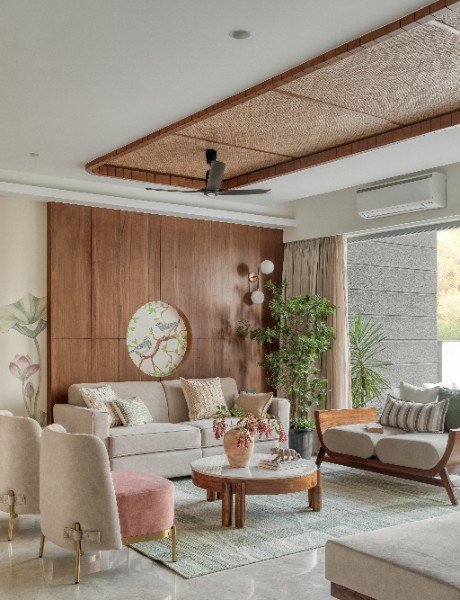
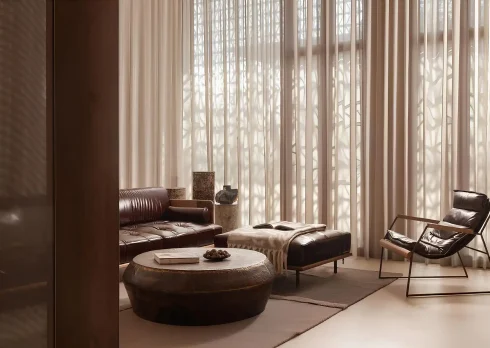
Ornamentation is not the only way to make a ceiling distinctive. At the aptly named ‘Canopy of Weaves’, a 2,410 sq ft apartment by Pune-based Alkove-Design, woven cane panels feature in the living and family areas, their woven surface picking up the earthy palette of the interiors. The client initially envisioned a wooden false ceiling, but the architects felt it would weigh down the composition. “Cane became the natural choice. It is light, rustic, and echoes the surroundings beautifully,” says Ninada Kashyap, Principal Architect at Alkove-Design.
The team looked to the project’s setting, with its views of a hillock, to guide the choice of material. “We wanted neither the ornamentation of tradition, nor the blankness of restraint,” they explain. Overhead, the cane forms a cocooning layer that sits in conversation with the rugged landscape outside.
5. The Warmth Of Brick and Porotherm Overhead by Wright Inspires
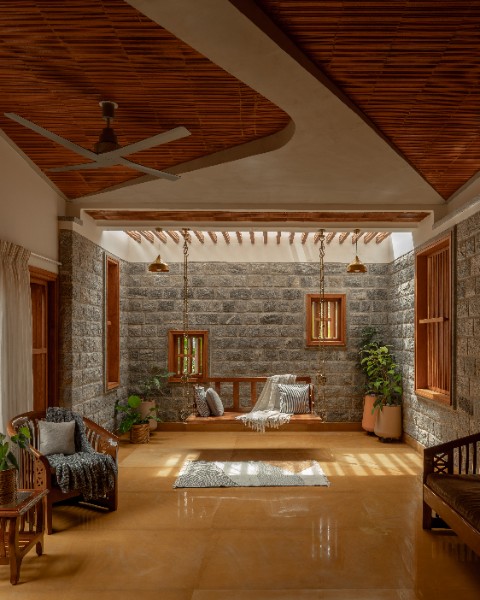
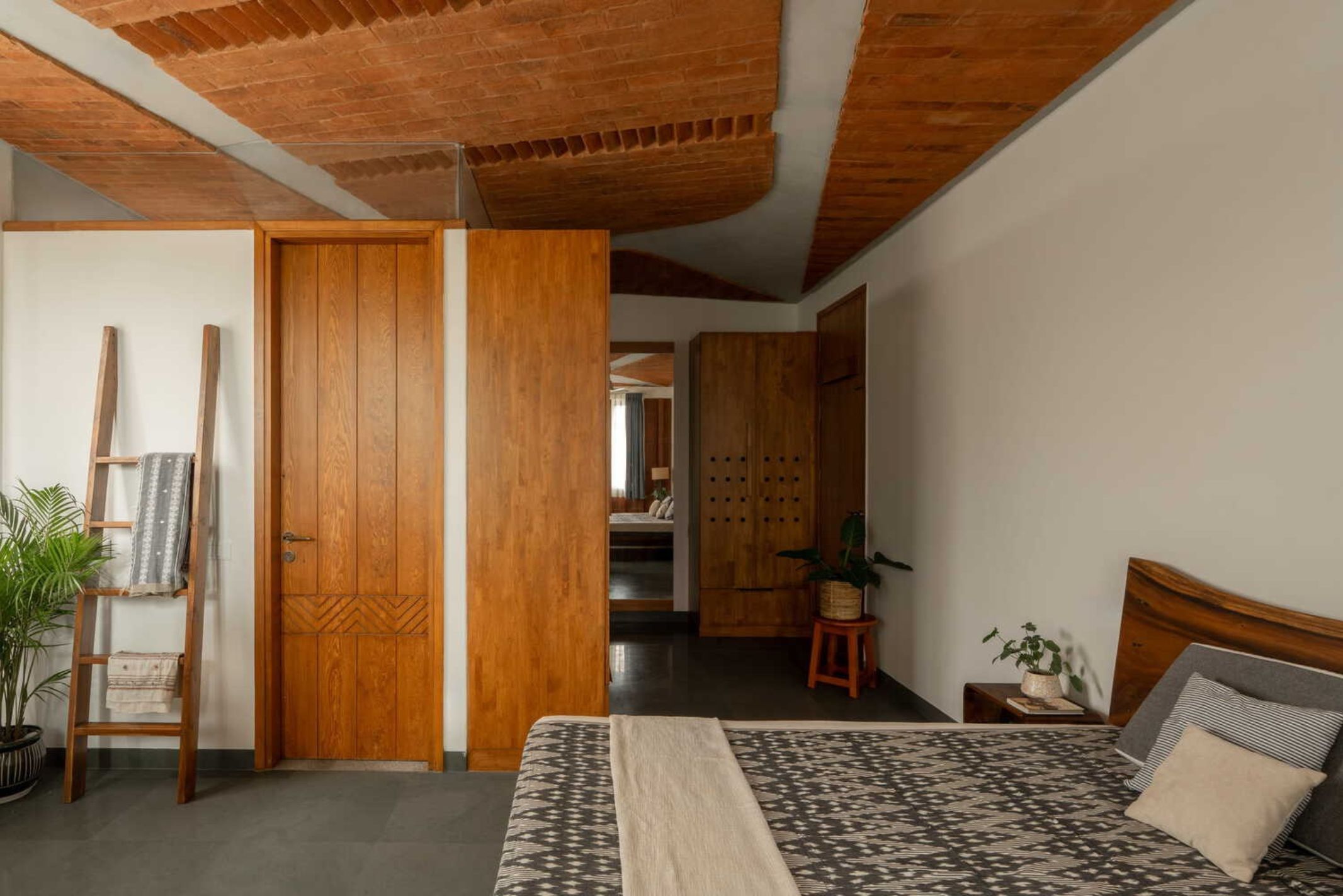
A ceiling can reflect the logic of how a house is built. At Taliru, a Bengaluru home by Wright Inspires, a filler slab, which reduces the amount of concrete in the structural slab, is left exposed by design, making a structural decision into an aesthetic one too. Porotherm clay blocks and brick replace concrete in the non-structural portions of the slab, bringing the material palette of the house overhead. With its pared-back palette of earthy tones and natural materials, the ceiling becomes another surface through which the home’s material language is expressed.
“While the filler slab serves a functional purpose, we consciously arranged the materials in a pattern to complement the overall colour palette and material language of the space,” says the team. “A filler slab, when designed with the right materials, can add a sense of warmth and cosiness to a space.” The result is a ceiling that brings together the practical benefits of the filler slab with the tactile quality of the materials used throughout the home.
Across these homes, the ceiling emerges as an integral part of the design rather than an afterthought. Whether painted, woven, carved or intentionally left exposed, it becomes another plane through which the character of a home can unfold, adding depth and dimension to the spaces below.