Anna Wintour Would Approve Of These 5 Walk-In Wardrobes
From the wallpaper-draped counters to the galleryesque displays, Design Pataki peeks into five walk-in wardrobes that reference the ancient royal dressing rooms.
- 20 Feb '26
- 5:13 pm by Simran Almeida

Conventionally, dressing rooms were an indulgence bestowed upon royalty. While the common masses were confined to metal or wooden built-in cupboards, almirahs, chests, or freestanding wardrobes. It wasn’t until the 1900s that hanging rods were incorporated into wardrobes, and one tiny closet per bedroom appeared in Dakota, an uber-luxurious edifice in New York. From dystopian hideouts to portals of fantasy, the walk-in wardrobe has long occupied a storied place in global literature. Its arrival in Indian homes in the late 20th century was a response to global cultural references and a growing appetite for spatial luxury. Although numerous homes still dwell in the closets of conformist norms, some conjured a room of secrets as a lineage of storied luxury. In this spirit, Design Pataki opens the doors to five hidden chambers where bespoke indulgence and refined rituals come together.
1. Drenched In Hues At Snn Clermont Residence by FADD Studio
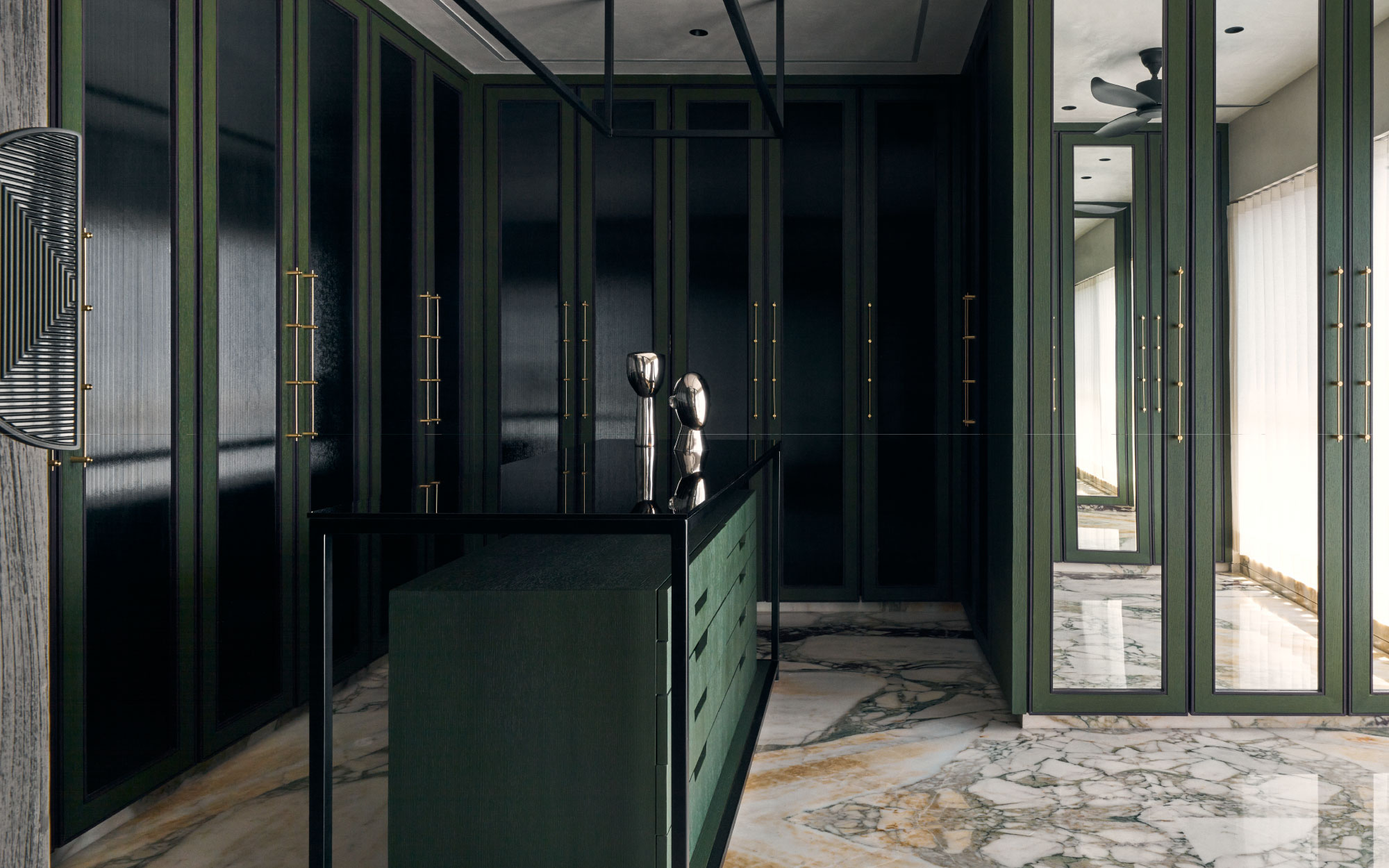
Ditching straight lines and conformist norms, FADD Studio curated a 7,800 sq. ft. home in Bengaluru’s SNN Clermont tower. This multigenerational family home borrows symbolism from the curved elements of nature. Transforming two separate units into a cohesive duplex, the home layers formal and informal spaces across a duo of levels, with spatial links guiding movement between shared experiences and private retreats. With wavy walls, a neutral palette, peach-pink marble flooring and a sculptural staircase, this abode adapts to distinct versions of voluptuousness. Within this contemporary sanctuary form, flow, and materiality converge. Veering from the bends within the home is a walk-in wardrobe that embraces sharp lines and brooding hues.
Drenched in deep olive and obsidian hues with hints of gold, “The master wardrobe is conceived as a balance of refinement and function,” notes Farah Ahmed of FADD Studio. While fluted glass shutters trace the perimeter, mirrored surfaces refract light, conjuring an illusion of capaciousness. “A central island anchors the layout, offering a practical surface for daily use, complemented by a suspended rod above for garments post-ironing, encouraging ease and flexibility,” explains Ahmed. Juxtaposing the crepuscular hues, a Golden Lava marble with purple, emerald, and gold veins infuses the space with magnificence while also adding a sense of airiness. “While it carries controlled maximal accents, the overall composition stays minimal, composed, and easy on the eye,” muses Ahmed.
Also Read: Inspired By Emily In Paris, This Mumbai Apartment is “Très Chic”
2. Tracing Nature’s Imprint At The Verdant Manor By Studio Goya
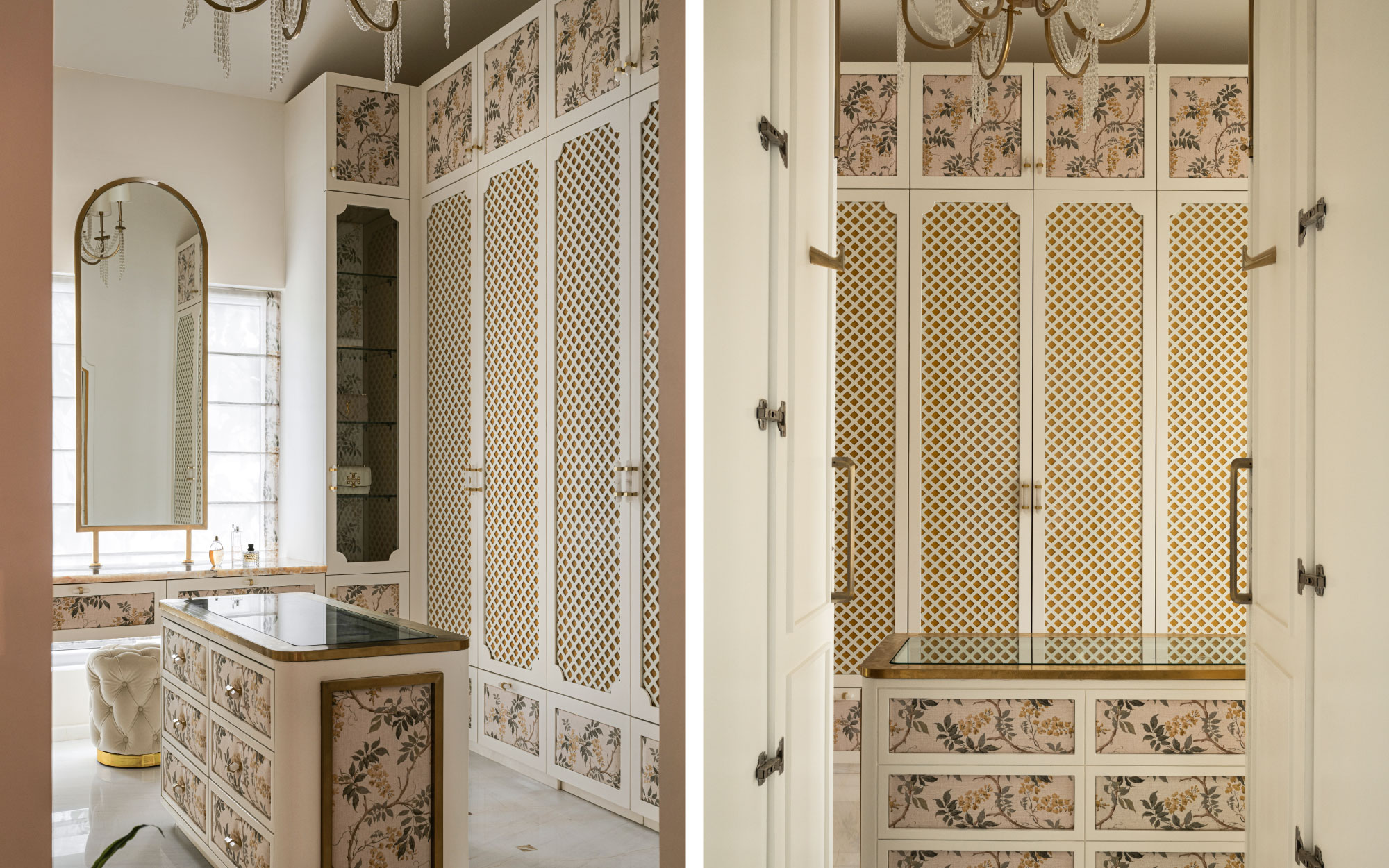
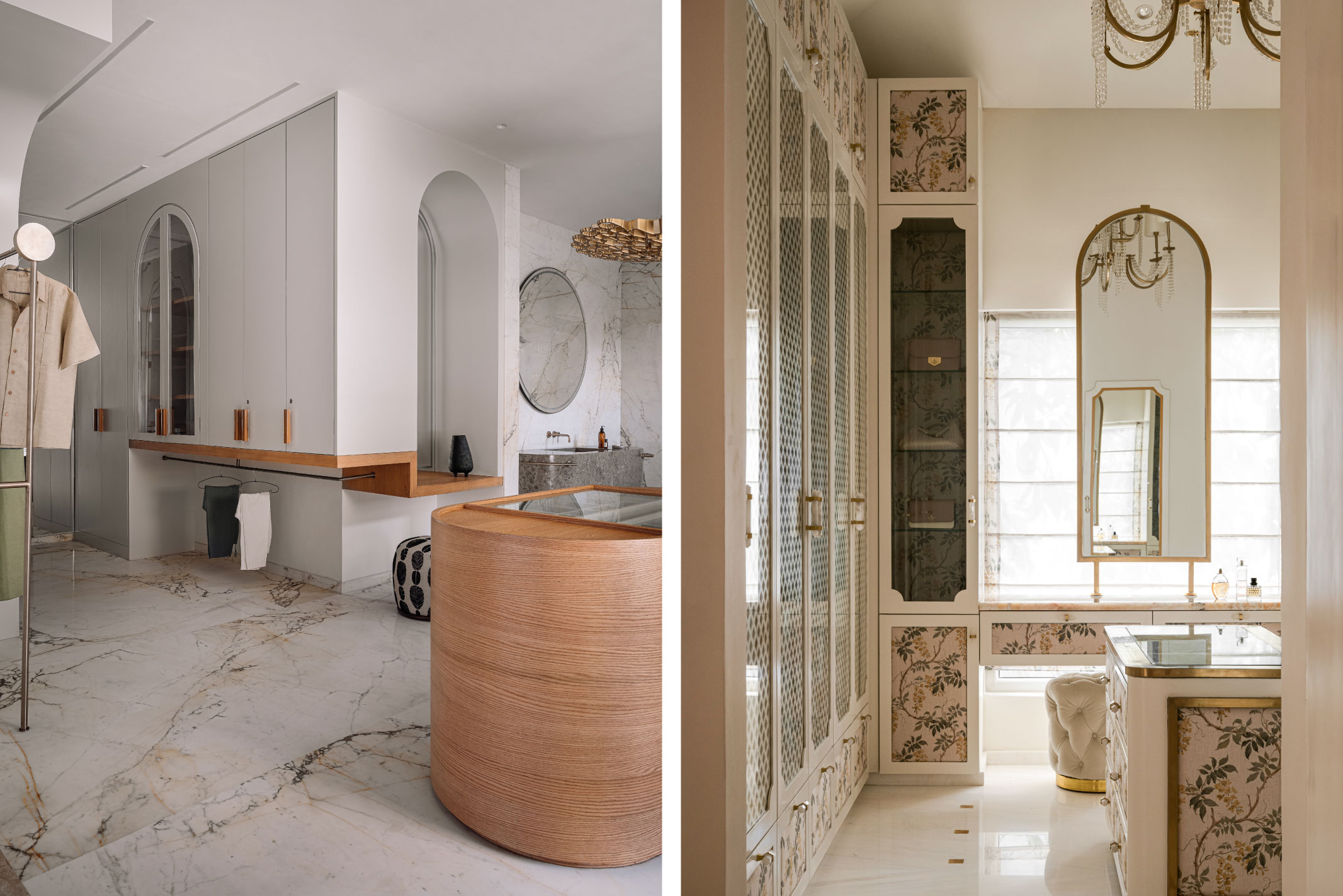
With natural landscape peeking from every corner, this 4,000-square-foot villa in Bengaluru unfurls, placing feeling, rhythm, and everyday intimacy at its core. Aptly christened ‘The Verdant Manor,’ this home by Studio Goya narrates stories of its inhabitants’ voyages. With arched openings softening the rigid angles and wood, wicker and woven accents imbuing warmth in every room, the home is a palimpsest of textures. With a pastel palette rendering it serene, while the natural light drenches it, the home, with its multifarious wallpapers, speaks of the couple’s affection for Indian sensibilities and bucolic charm. Set within this sanctuary, the walk-in wardrobe gently conjures nature’s symbolism through a muted palette and an air of understated grandeur.
The wardrobes trace the room’s perimeter while a central island celebrates functionality. The space unfolds beneath a stream of natural light filtering through a floor-to-ceiling window, gently highlighting a dressing area marked by arched mirrors. “The concept embraces florals not as mere decoration, but as a storytelling device, bringing a sense of movement, femininity, and individuality into the space,” shares Akshita Mehra of Studio Goya. With cabinets alternating between cane-latticed and floral shutters, and a gilded chandelier overlooking the entire choreography, the space is a harmonious interplay of vintage nostalgia, muted tones, and personal narratives. “Ultimately, the wardrobe is designed as a confident yet intimate space which is expressive, joyful, and personal,” muses Mehra.
3. A Tryst With Minimalism At Sakura By Ikigai Studio
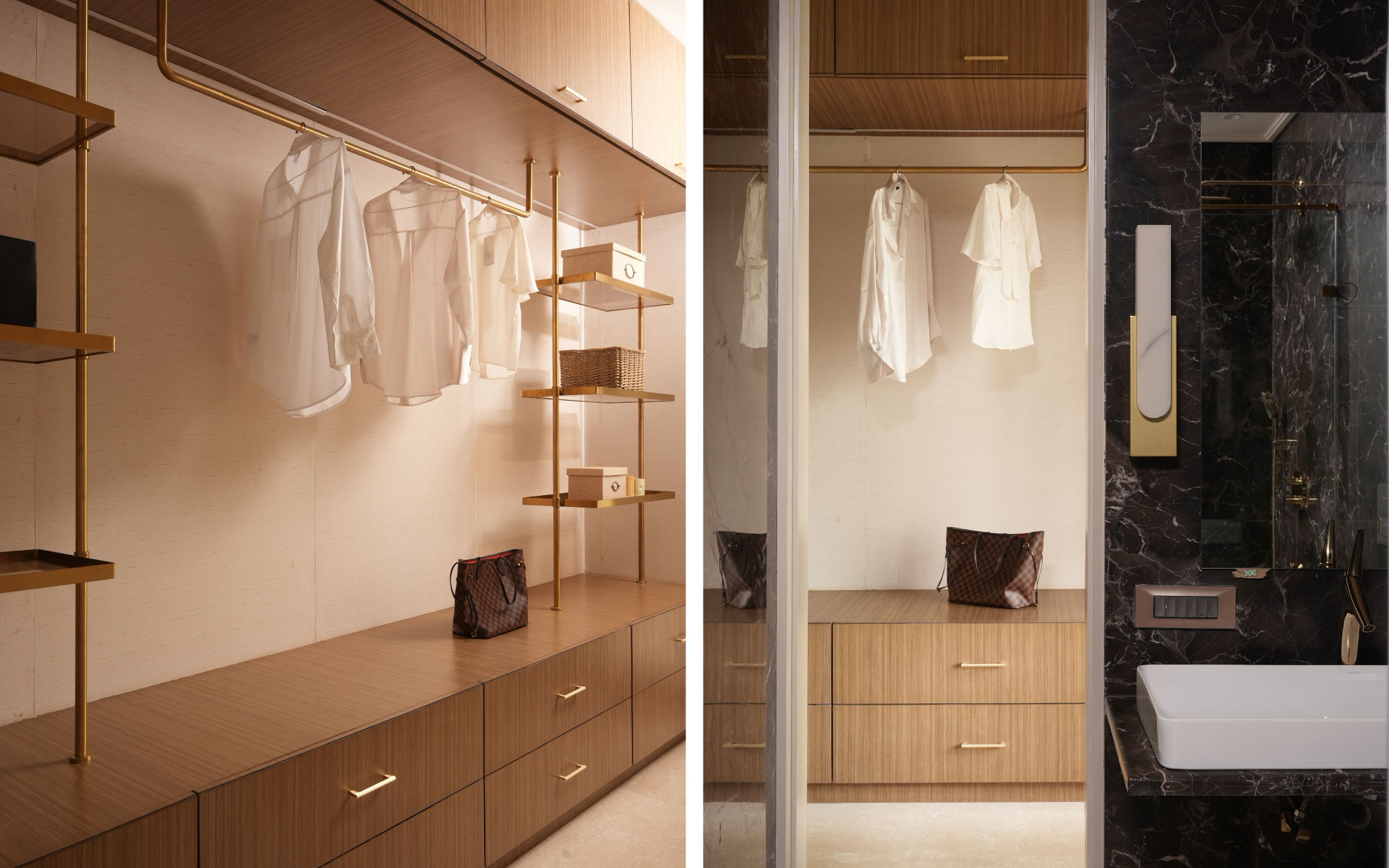
Rooted in the calming essence of neutrals, a 2,400 sq. ft. home in Pune by Ikigai Studio witnessed the new beginnings of a young couple. Dubbed ‘Sakura,’ this home is embellished with monochromatic niceties, wooden accents and veining of natural stone, all while quietly concealing intimate moments. Beneath this minimalism lies a moment of drama orchestrated by a cobalt-hued room, patterned wallpapers telling tales, and the Ikigai Room with cherry blossom murals, which lends the home its name. In keeping with the minimalist character, the abode features a wardrobe rendered in warm wood, its centre punctuated by slender gold rods that introduce a quiet note of opulence.
With functionality at its core, the brief called for a walk-in wardrobe that unfolds seamlessly after everyday rituals, naturally positioned just outside the bathroom. “I believe that wardrobes are deeply personal spaces,” remarks Anuja Marudgan of Ikigai Studio. The space reveals itself as a minimalist sanctuary, where a sleek wardrobe settles seamlessly into the room’s austere composition. “The remaining shelves were designed to accommodate accessories and additional clothing, while the drawers below store items they prefer to keep out of sight,” points Marudgan.
Also Read: House Of Arches Decor: A Homegrown Showcase
4. Influences Of Heritage At The Rehethaan House by MuseLAB
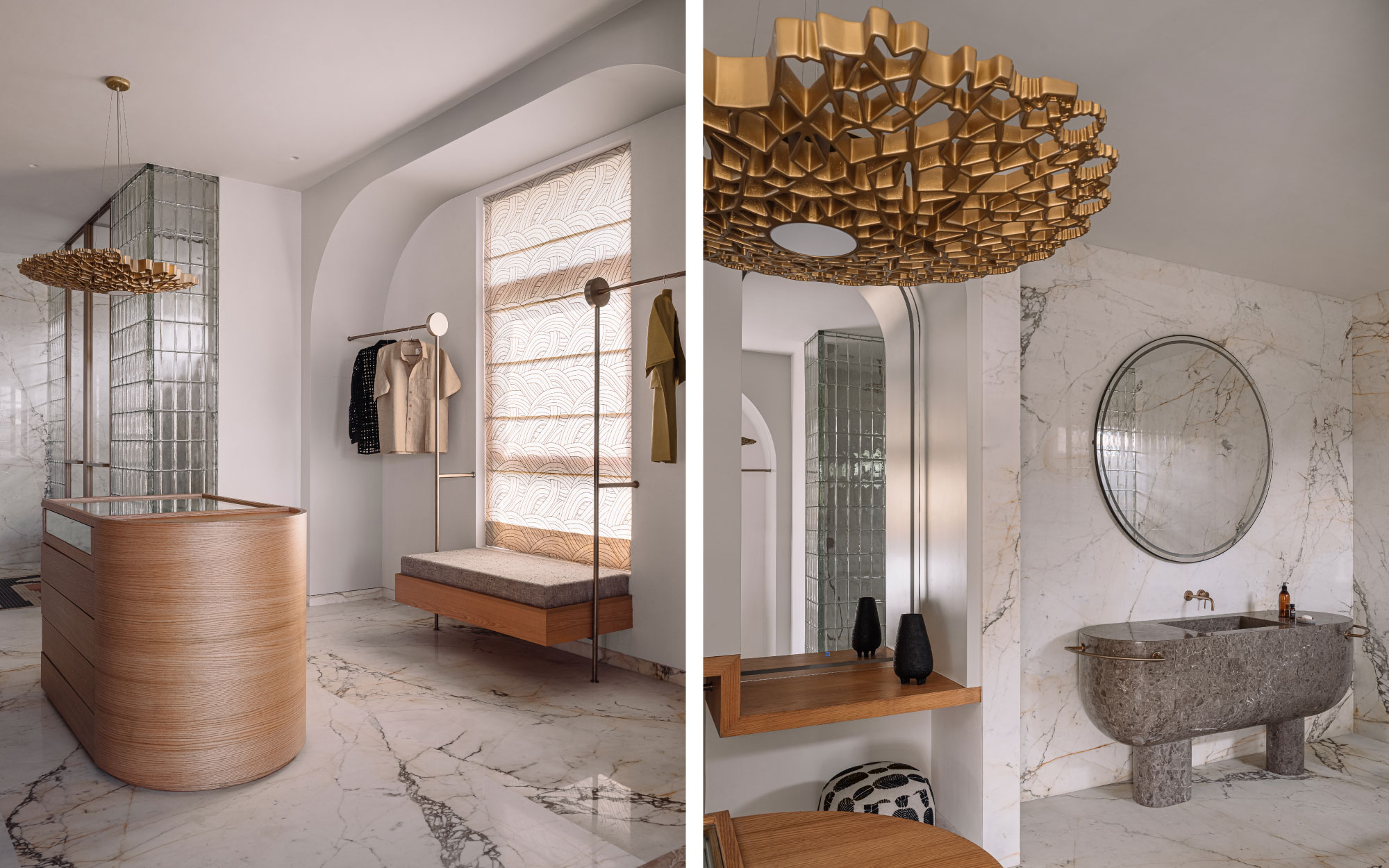
A 13,000 sq. ft. home in Gujarat, aptly christened ‘Rehethaan,’ takes its cues from the locale, as Mediterranean and Mid-Century architectural features collude. Designed by MuseLAB, its elements draw from the rich treasure trove of Gujarat’s artisanship and the textile motifs of Kutch; the spaces unfurl as a balance of scales, geometry, and light. With corridors conceived as gallery-esque spaces, dual-toned vaults arching over doorways, and intricately etched ceilings, the home speaks of crafts that are fading traditions. In this motley crew of elements, reinterpreting traditions is a walk-in wardrobe, reinforcing the home’s larger theme of fluid transitions between spaces.
Positioned within the son’s bedroom, this walk-in wardrobe features arches, vaults, and hooded lintels, a recurring theme within the home. “The design adopts architectural elements used consistently across the residence,” note Huzefa Rangwala and Jasem Pirani of MuseLAB. In keeping with the museum-like areas, this space contains a panoply of storage allowing movement to coexist. “The niches function both as storage and as architectural recesses, aligning with the project’s emphasis on depth, proportion, and articulation through form,” explain the designers. embodies the project’s ethos of fluid spatiality, harmonious materiality, and exquisitely controlled detailing.
5. A Monochrome Realm At The House Hydrangea from Studio i & Co.
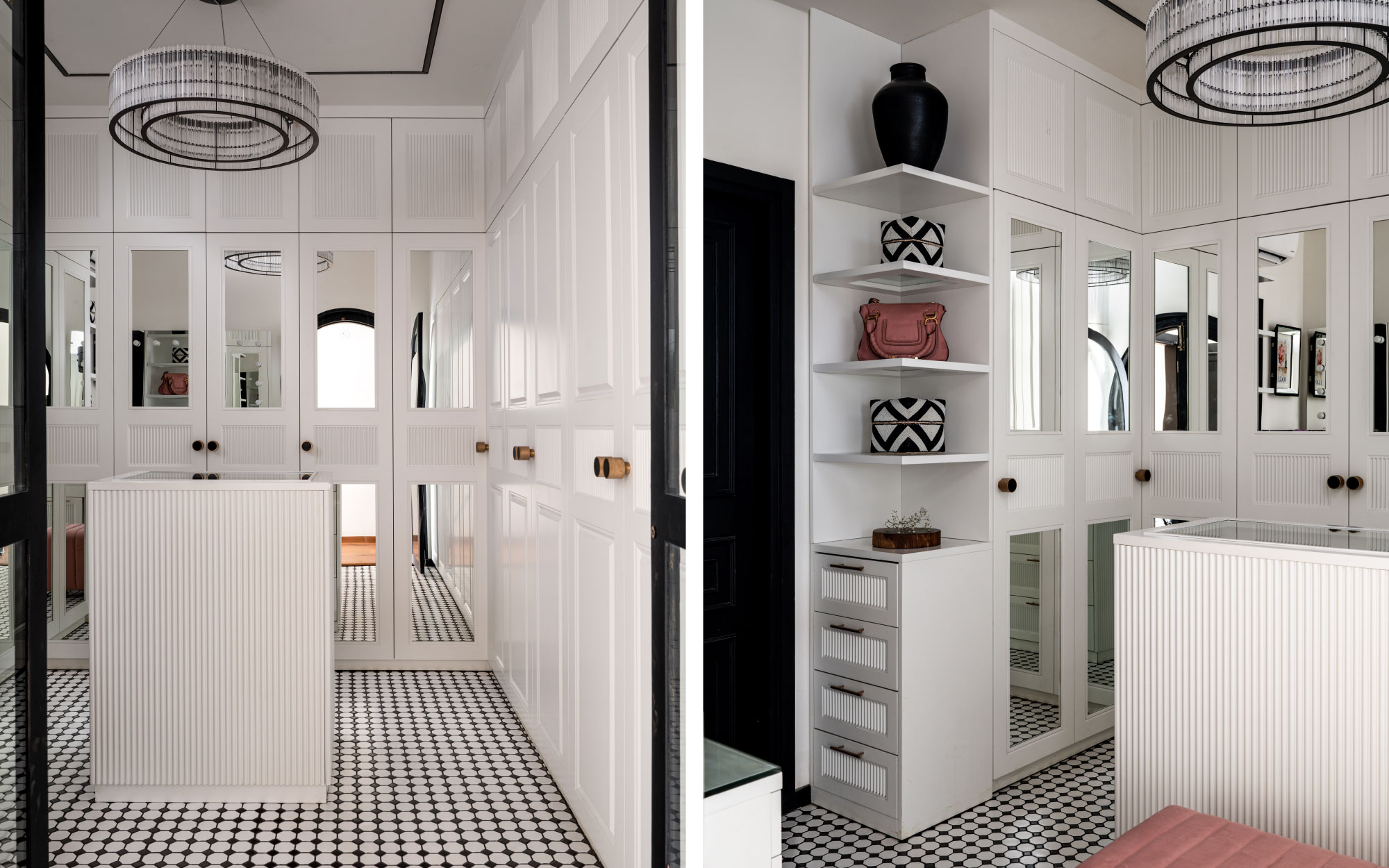
Referencing the Gestalt principles of design that emphasise how humans distinguish patterns and condense complex images, a minimalist home designed by Studio i & Co. comes to life in Bengaluru. Steeped in monochromatic hues and punctuated by bougainvillaea and hydrangea accents, this 1,500 sq. ft. home reveals a space within a space, where every zone folds into another, echoing the mind’s instinct to find beauty in synthesis. Guided by this principle, the layout carves out interconnected functional zones, while a figure–ground dialogue allows each element to shine without intruding on the spatial harmony. Within Gestalt’s artistry is a walk-in wardrobe that mirrors the home’s palette to foster a sense of harmony, balance, and flow.
The wardrobe is the result of merging two bedrooms and reclaiming a portion of the adjoining passage. The room emerges dressed in white-washed and mirrored shutters that trace its periphery, while a black-and-glass chandelier harmonises effortlessly with the space’s restrained palette. “The focal point of this room is the mosaic tiles in black and white,” remarks Iesha Parekh Shellugar of Studio i & Co. Anchored by a fluted wooden island counter, alongside a vanity and open storage, the layout comes together as a layered composition, echoing the idea that detailing transforms fragments into a harmonious whole.