A Wonder Room Ushers In A New Creative Chapter For Abu Jani Sandeep Khosla With A Gilded Mumbai Flagship
In conversation with Sandeep Khosla at Mubarak Baug, Abu Jani Sandeep Khosla’s newest flagship designed by A Wonder Room, we unwrap the art and design gallery’s serendipitous origins.
- 19 Aug '26
- 11:24 am by Simran Almeida

Bombay’s Art Deco had transpired just a few decades before Sandeep Khosla and Abu Jani serendipitously met while the former was visiting the city. Decades later, their newest flagship within the iconic Framjee Cawasjee Institute in Mumbai is more than a celebration of 40 years of their haute couture. It is the first physical manifestation of A Wonder Room, the fashion vanguards’ interior design extension, which converges art, craft, objects and imagination to create spaces where wonder is tucked into every crevice. Monikered ‘Mubarak Baug,’ meaning ‘a garden of celebration,’ this 20,000 sq. ft. gilded realm is conceived by A Wonder Room, translating the duo’s Indian Maximal aesthetic into an ethereal dreamscape. It is set to be headquartered in Goa later this year, bringing together craftsmanship and contemporary design through Abu-Sandeep’s distinctive India Maximal imagination.
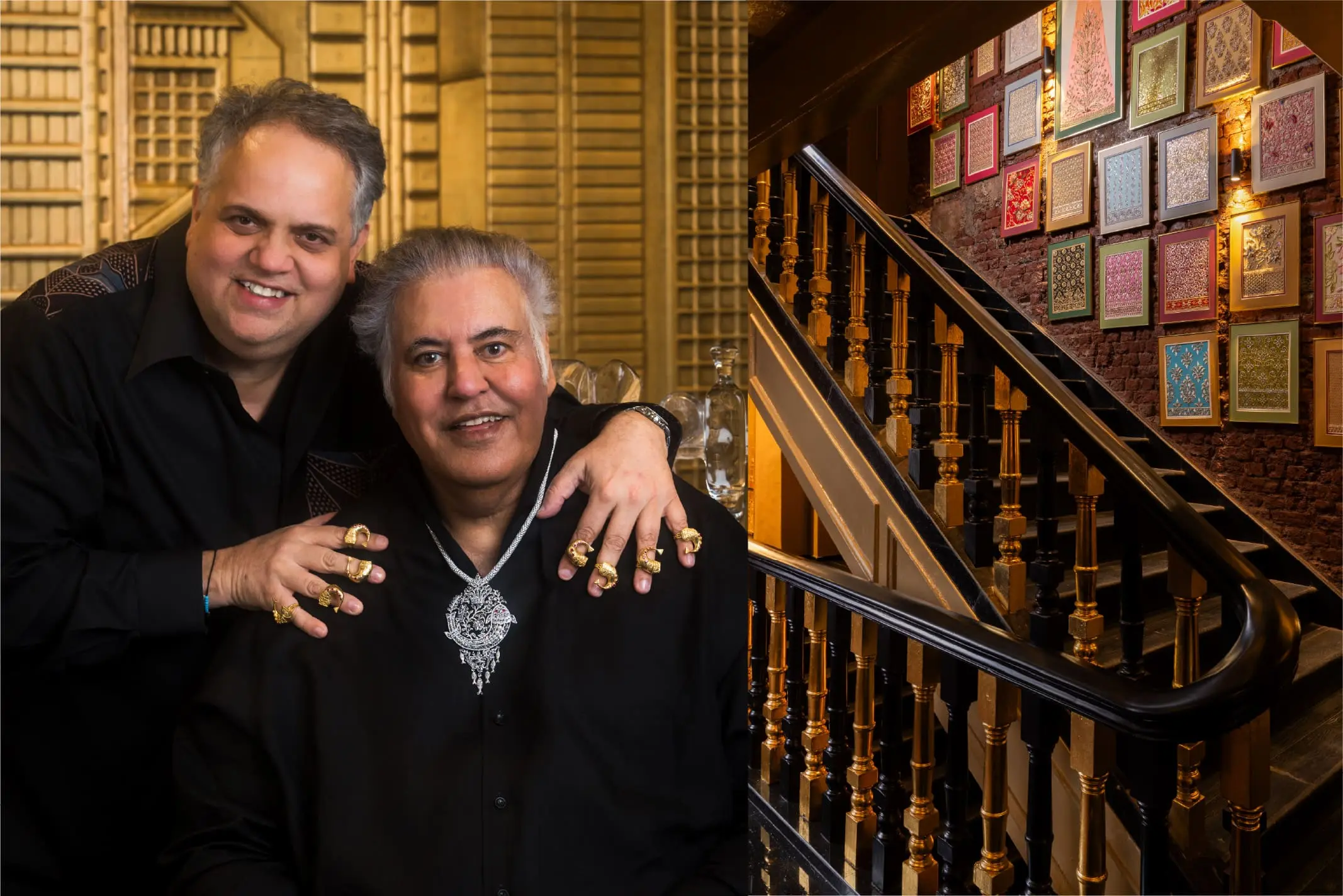
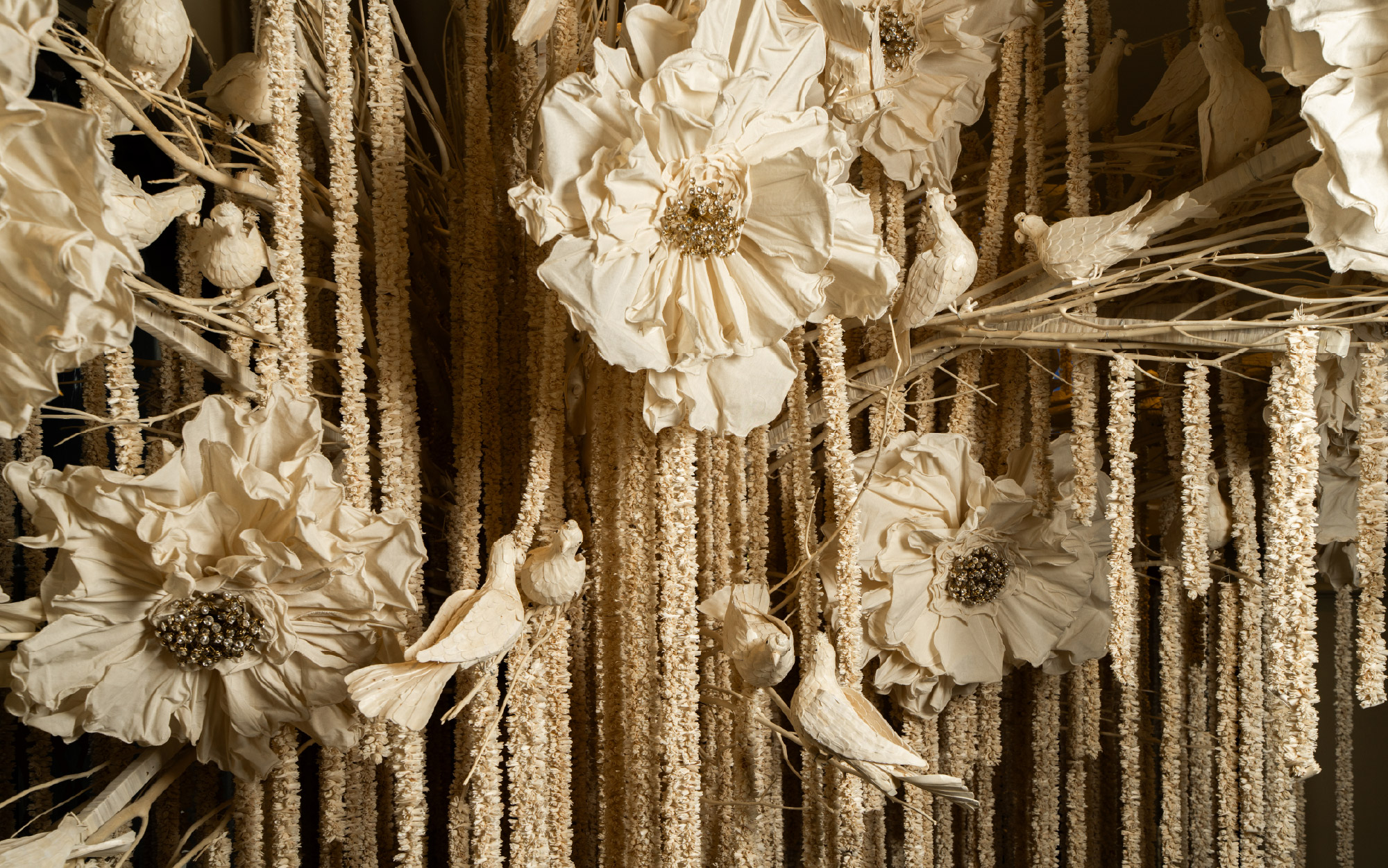
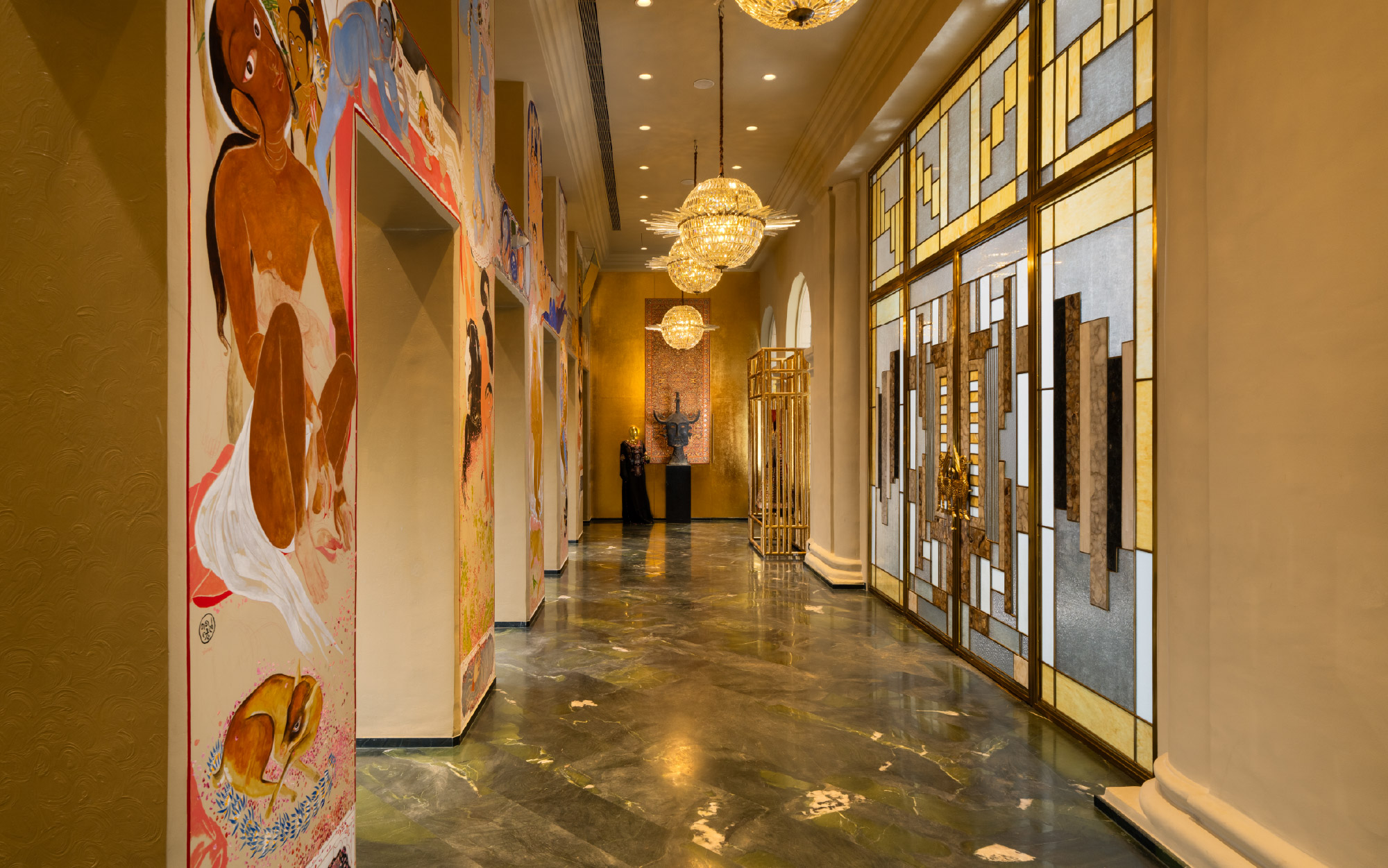
Under the sombre skies of Mumbai’s relentless monsoon, the flagship opens like a gilded silver lining, beginning with a geometric marble-and-gold door that sets the tone for the theatrical world within. Inside, the duo’s Midas touch reveals itself in brass-clad walls embellished with murals by artist Shine Shivan, while a tribal mask, reimagined as a ‘Nazar Battu’, presides against a crimson carpet. The murals tell tales of lord Krishna and his friend Sudama, Mughal emperor Akbar and Moinuddin Chishti, while at the edges lie mogras that infuse an indolic fragrance, lending an almost uncanny realism to the nearby Shola tree in full bloom. An inverted brass city overlooks the gilded bamboo shelves, 300 intricately carved Gujarati windows and geometric mirrors.
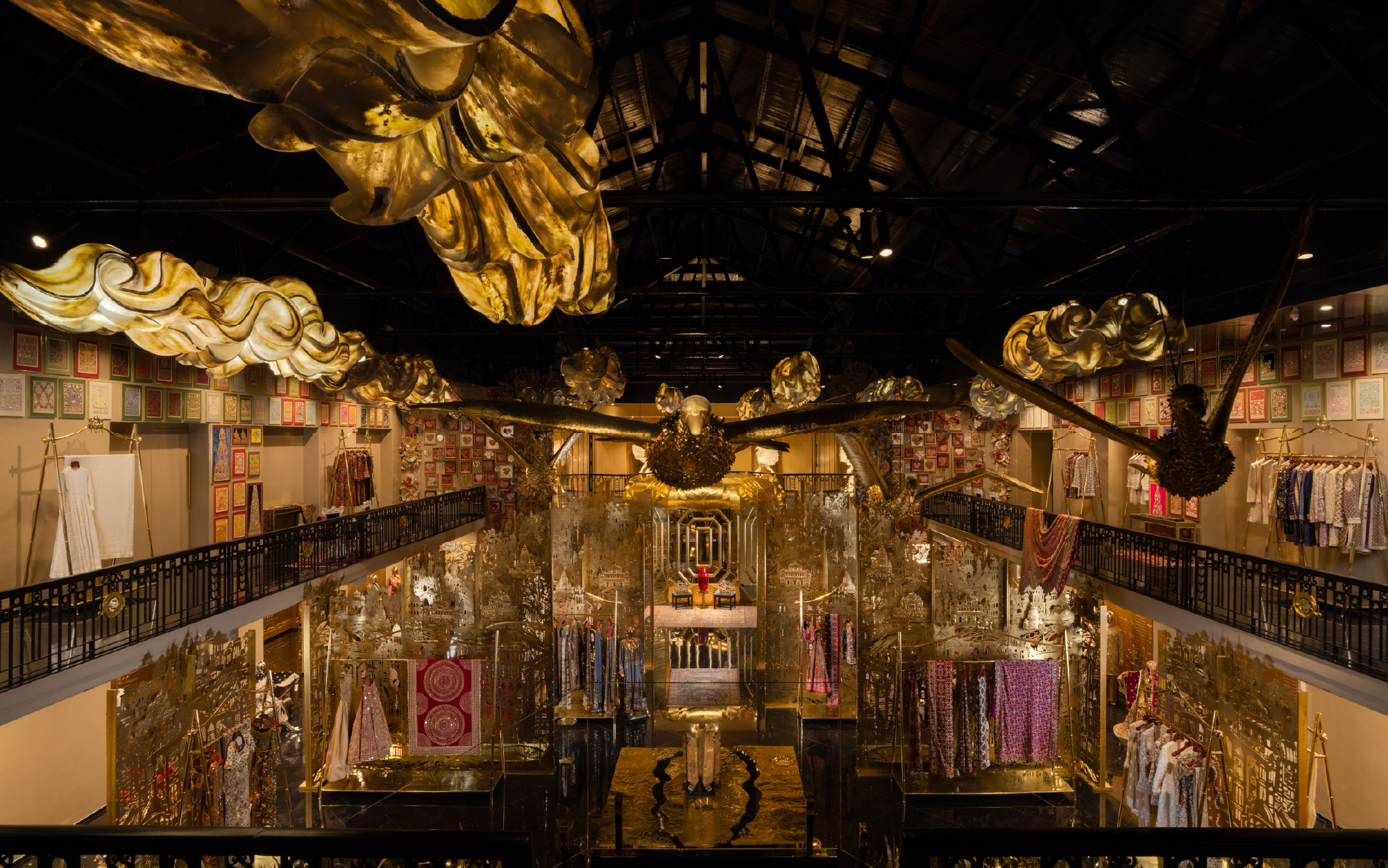
Ahead, a dimly lit sequence of wooden stairs leads to a midlanding where portraits by artist Veeraj Nair share fragments of Mumbai with the viewers. Above, a brass wall embossed with the city’s skyline pays homage to Mumbai’s second-largest collection of Art Deco edifices. It is then that we enter into another trompe-l’œil illusoriness of A Wonder Room, where colossal brass panels by artist Shilo Shiv Suleman rise like gilded cityscapes, their surfaces etched with intricate urban vistas that form a theatrical backdrop to the haute couture on display. Nearby, a vast wall shimmers with fragments of the duo’s past garments, meticulously layered with Wolf Jaipur by Ritu and Surya Singh to give their discarded embellishments a new life, all while honouring Indian craftsmanship.
Design Pataki: What’s the inspiration for the name ‘Wonder Room’ within Mubarak Baug?
Sandeep Khosla: Many years ago, we were shooting for our book called ‘India Fantastique’. It is a fashion and interior book. For this book, we had a friend from France who was shooting it cover to cover in our Goa home, going from one room to another. And she said, Abu Sandeep, I will tell you one observation I made. In all your homes, everything has a surprise and is unexpected. You create these beautiful wonder rooms. Where every room has something, whether it’s the art, the way things are placed, a piece of furniture, or a piece of silver or sculpture. It’s all integrated so well together that it takes you by surprise.
Just the same way as ‘Mubarak Baug.’ When you enter and look around, you think you have entered a world, and that’s the end of the store. Then suddenly you walk up the stairs, and you discover more. Walking up to the passage upstairs too, you are in shock at the little pieces of art, and that’s why the name is ‘A Wonder Room.’
DP: In Mubarak Baug, there are references to Mumbai’s Art Deco legacy. How did you interpret those influences with your maximalist approach, and what was the process of translating them?
SK: Art Deco has always been present in our clothes. But Abu draws, so it’s our version of Art Deco. It’s not like we pick up a motif and place it as is. It’s always our interpretation and has been present in our clothes. Art Deco is very close to our heart. We love Art Deco jewellery, too, especially old jewellery, made in the same style. So even in homes, we love Art Deco cabinets, chairs, beds, as there is so much Art Deco detailing. It’s simple at the same time, but we do our maximal version.
“It’s Art Deco on acid.”

DP: Your maximalist aesthetic is unmissable even at the Flagship. However, in a home, how do you balance maximalism and the client’s vision?
SK: Abu and I believe that when you go to an artist to design a space, it has to be their style. We always try to adapt to a client’s lifestyle. But why has anybody come to us? They’ve come to us because they have an aspiration and because they trust us with a certain design aesthetic. Our homes are not about walls and floors; it’s about art, about creating installations, like little pieces of wonder.
And literally, our projects are designed very differently. We think about the bigger pieces before we even start. Then we get a massive painting of Shine Shivan here. We buy a painting, then we start designing the wall and space around it so it adapts the colour; it’s not a cold space. I find that people think design is just about flooring and walls. Putting one antique, sculpture or painting somewhere has no consequence and doesn’t tell any kind of story. It’s like a colour patch. There has to be a story to each thing, whether it’s a table or a ceiling.
For clients who work with us, it’s an education for us to learn about them and vice versa. We go out for a meal with them and get to know where their heart and mind are. We do a little study on our client, just like when we are doing a bridal order. We ask questions and not just say “I’m going to make you a red dress.” You know, it’s about a story. And once we know them, we lead them through art and antiques, which invariably starts in the thrift market. The first trip is to the Jaipur gullies or Bombay Chor Bazaar, which has become so commercial. We’re losing such wonderful character. But that’s where the journey begins.
DP: What is the one thing you are very specific about when designing a home?
SK: We are so particular about carpets. We love old jail carpets, and the beauty is that everything is available today and is also being reproduced. So if you want a new jail carpet, you’ll get the same design woven as well. Kashmir still does beautiful carpets. India is a blessed country in a way with the art and craft. Because it’s (the craft) alive, and hopefully it will remain alive for a very, very long time to come, though China is making machine carpets. The Iranian rugs you’re buying, they’re doing silk carpets on machines now, and you won’t even know. It’s the same with embroidery on clothes. Everything in Surat is being computerised or machineised. It’s a sad reality. But at least our generation is enjoying it, and probably the next generation will enjoy it, too. I am unaware of what the scenario will be 20 years from now.

DP: Your work celebrates embroidery, Shola and brasswork. Is this your way of redefining what Indian craftsmanship can be in contemporary design?
SK: If you look throughout the store, we’ve got this work with Wolf, who are an artist couple from Jaipur, working with waste, and they really made magic out of it. We sent them a truck full of our waste in gunny bags and gave them a basic brief. It took them a year to make the flowers with red bangles. It was because we do wedding orders here. That’s what the whole thing is about: details.
Also, brass is a medium we love. It’s also a very difficult medium to work with. So, whether it’s the birds outside, the whole floating city downstairs, or all the panels, we’ve designed it with A Wonder Room. Shilo Shiv Suleman, an artist, has actually made the panel piece—she’s responsible for those things, and then we worked with Shine Shivan downstairs for the big painting downstairs.
DP: How did the collaboration with Shine Shivan come about?
SK: I went to an exhibition of his, and just loved what he does. His larger-than-life figures, his use of colour were so reminiscent of things we do.
People actually run shy, thinking, ‘How am I going to just come to the house every day and see a black wall, or see a red wall?’ But just do it! Just do it once, and you’ll start enjoying it. You have to have the guts to live differently and experience design.
DP: A Wonder Room brings together various artists. How do you preserve the individuality of each craftsperson while ensuring the final work still speaks in one voice?
SK: So, the painter is given special finishes to do. He is honoured because he does ten finishes, and then we mix and match. For the craftsman, working with us, we’re doing something different; it’s not very mundane. So, even for an artisan doing brass work, at the end of the day are proud of it, because they can claim, ‘I have done this job.’ Otherwise, everybody is doing just a run-of-the-mill job. For them too, it’s a learning curve. It’s just like when we started Chikankari at a factory in Lucknow, 35 years ago. A Chikankari block rides on a stitch, and you have to follow its stitch pattern. There we were picking up complicated blocks; he kept telling us it was impossible to make, but then we found older craftswomen. And it’s the same thing we do with our Wonder Rooms. How our homes are going to come around in the end, nobody knows except us. You have to expect the unexpected; imagination to be in tune with us in a certain manner.
‘Everything’s in the detail.’
DP: What is the most invisible design decision at Mubarak Baug that you’re personally proud of?
SK: When we first came here, Mubarak Baug was a working lighting showroom, and it was brightly lit. So the magic was missing, as every time A Wonder Room put up a panel, it just looked flat. We had to reduce the lighting by 60% to create the ambience. In all retail experiences, people like to have a lot of light because they think the colours are better, because you’re brought up with what your grandmother did. But there is a subtlety in not showing everything; it leads you to discovery. A discovery of light, shadow and details.
Everything has to have a vibe to it, and one of our specialities at A Wonder Room, all the places we do stand the test of time, making all the people in it comfortable, even if they are there for a very short period of time. Also, for the homes that we’ve done, people say they feel as if they have been living there forever. It’s warm despite so many new things to live with, but the clients feel as if they belong.
Also Read: Who Owns The Goddess? Indian Art And Fashion’s Originality Problem Isn’t What You Think
DP: Can you describe this space in one word?
SK: Wonderful.