
#DP Talks: Khushboo Bansal On How Jodhpur Airport Brings Rajasthan’s Heritage To Life
New Delhi-based multidisciplinary architectural practice STHAPATI unveiled a newly completed terminal at Jodhpur Airport
- 31 Jul '26
- 4:41 pm by Simran Almeida

Magnificent palaces, flamboyant edifices, vast deserts and a tryst with India’s hospitality together form the first impression of Rajasthan. Established as India’s largest desert state, Rajasthan is a land where centuries of tradition flow effortlessly into the routines of contemporary life, making it almost impossible to discern where one ends. It is this enduring tapestry of heritage, culture and hospitality that continues to draw travellers from across the globe, with tourism contributing around 12% to the state’s GDP. In keeping with this, Airports Authority of India (AAI) has commissioned the New Delhi-based multidisciplinary architectural practice STHAPATI to design a new terminal at Jodhpur Airport.
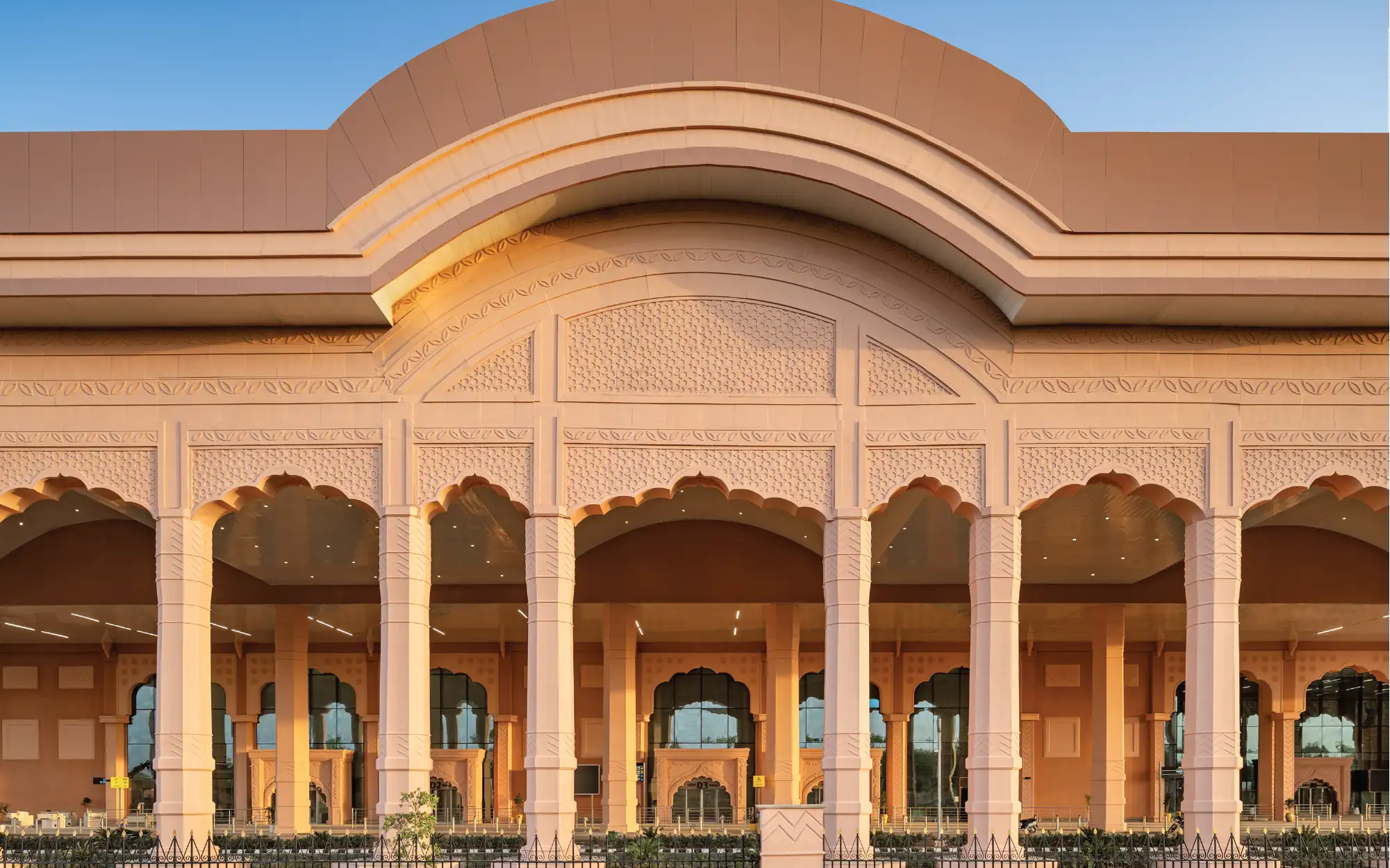
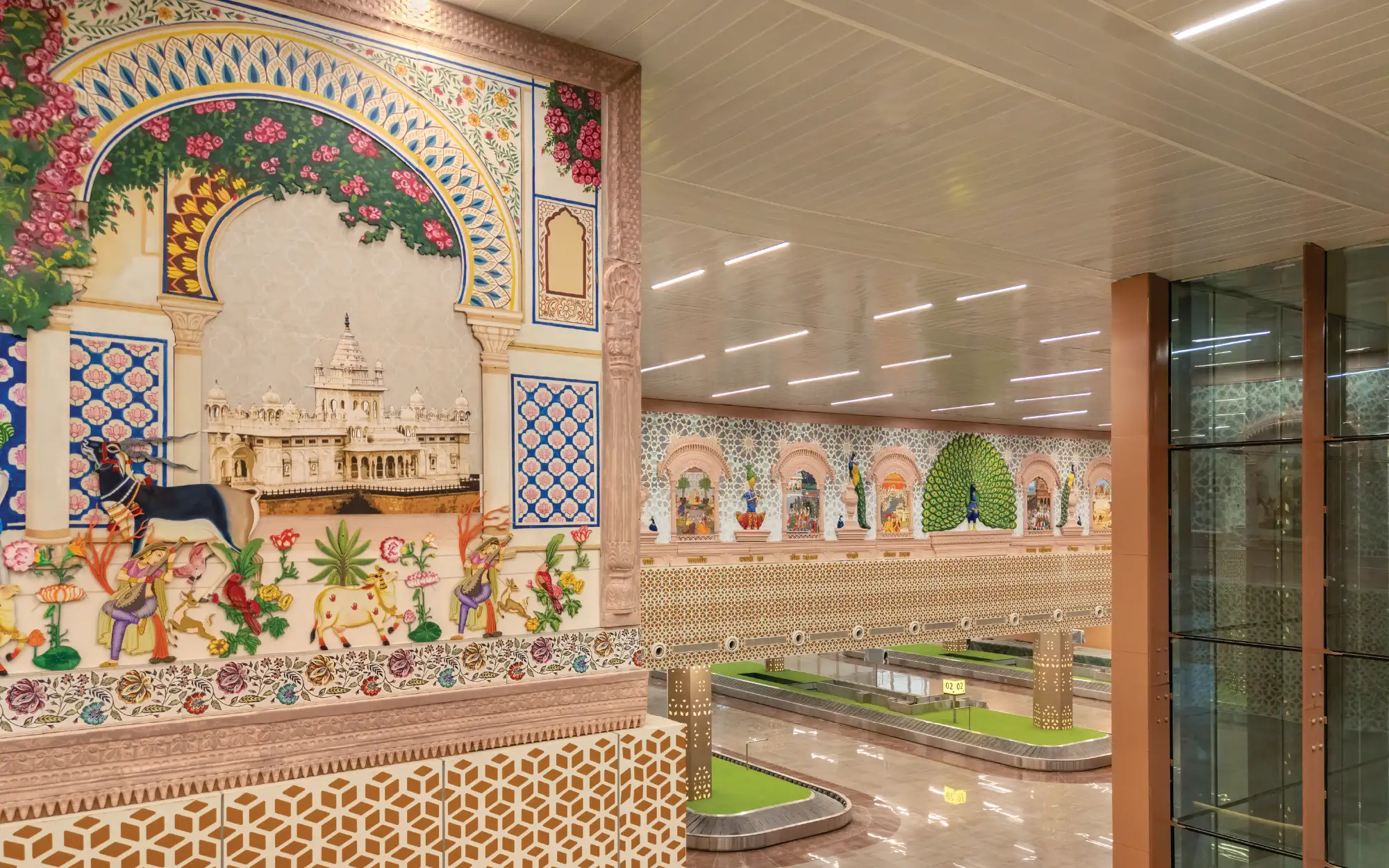
Extending the legacy of the Jodhpur Flying Club, envisioned by Maharaja Umaid Singh, the terminal anchors itself on the edge of the indigo-hued old city. The terminal’s layout champions functionality to minimise processing times. Its design borrows from elements of Rajputana architecture, with the facade featuring multifoil arches and a fluted dome set atop a lotus base crowned with a kalasa. While the interiors unveil murals of magnificent gardens, royalty, peacocks and jharokha motifs celebrating the artistic heritage crafted by Mr Mahendra Kodwani.The terminal integrates natural ventilation hacks that reduce solar heat gain while prioritising water conservation. To unravel the challenges, ambitions and design strategy behind the project, Design Pataki sits down with Principal Architect Khushboo Bansal of STHAPATI.
Design Pataki: What is the role of design in places like airports that are so dynamic in character?
Khushboo Bansal: Airports are often the first and last experience visitors have of a city. That gives them an important cultural role beyond transportation. They are among the most complex public buildings because they bring together movement, operations, security, and public experience within a single environment. Design plays the role of organising this complexity into spaces that feel intuitive and accessible. Beyond operational efficiency, airports are also the first and last impression of a city for a traveller. They therefore have the opportunity to express regional identity while creating environments that are comfortable, adaptable, and resilient.
DP: How does the Jodhpur Flying Club play a role in Rajasthan’s Aviation history?
KB: Maharaja Umaid Singh established the Jodhpur Flying Club in 1931 at a small airfield beside his Chittar Palace, now known as Umaid Bhawan Palace, introducing aviation to the desert landscape of western Rajasthan. Under his patronage, Jodhpur emerged as an important stop on international air routes, positioning the city within India’s evolving aviation network while remaining deeply connected to its royal legacy. The new airport terminal builds upon this historic association.
DP: What was the brief for the airport, and how did it shape your design response to the challenges of building in a desert setting?
KB: The brief was to create a future-ready terminal capable of efficiently accommodating growing passenger demand. Our response was to develop a building where planning, environmental performance, and architectural expression worked together from the outset. Designing the new terminal at Jodhpur airport required balancing contextual expression with the technical demands of a contemporary aviation facility. One of the key challenges was integrating a steel structural system and GFRC with a visual language inspired by Jodhpur’s heritage. The region’s hot, arid climate also played a significant role in shaping the design. It influenced the construction planning, material handling, and on-site execution during extreme summers. Addressing these challenges required close collaboration between the design, engineering, and execution teams, ensuring that technical performance, environmental responsiveness, and contextual design remained at the forefront of the project.
DP: Jodhpur’s forts, palaces, and historic residences draw from the Rajputana and Islamic architectural legacies. How does the airport’s design embody the historical ties?
KB: The design is inspired by the heritage architecture of Jodhpur, by understanding the language and recrafting it in terms of scale and materiality. Elements such as domes, multifoil arches, jharokha-inspired openings, and articulated columns informed the terminal’s architectural language. The result is a building that acknowledges Jodhpur’s architectural legacy while expressing it through a modern infrastructure typology, allowing the terminal to feel rooted in its context without becoming an interpretation of the past.
Also Read: The Stunning Revival Of Odisha’s 200-Year-Old Rambha Palace By Architect Channa Daswatte
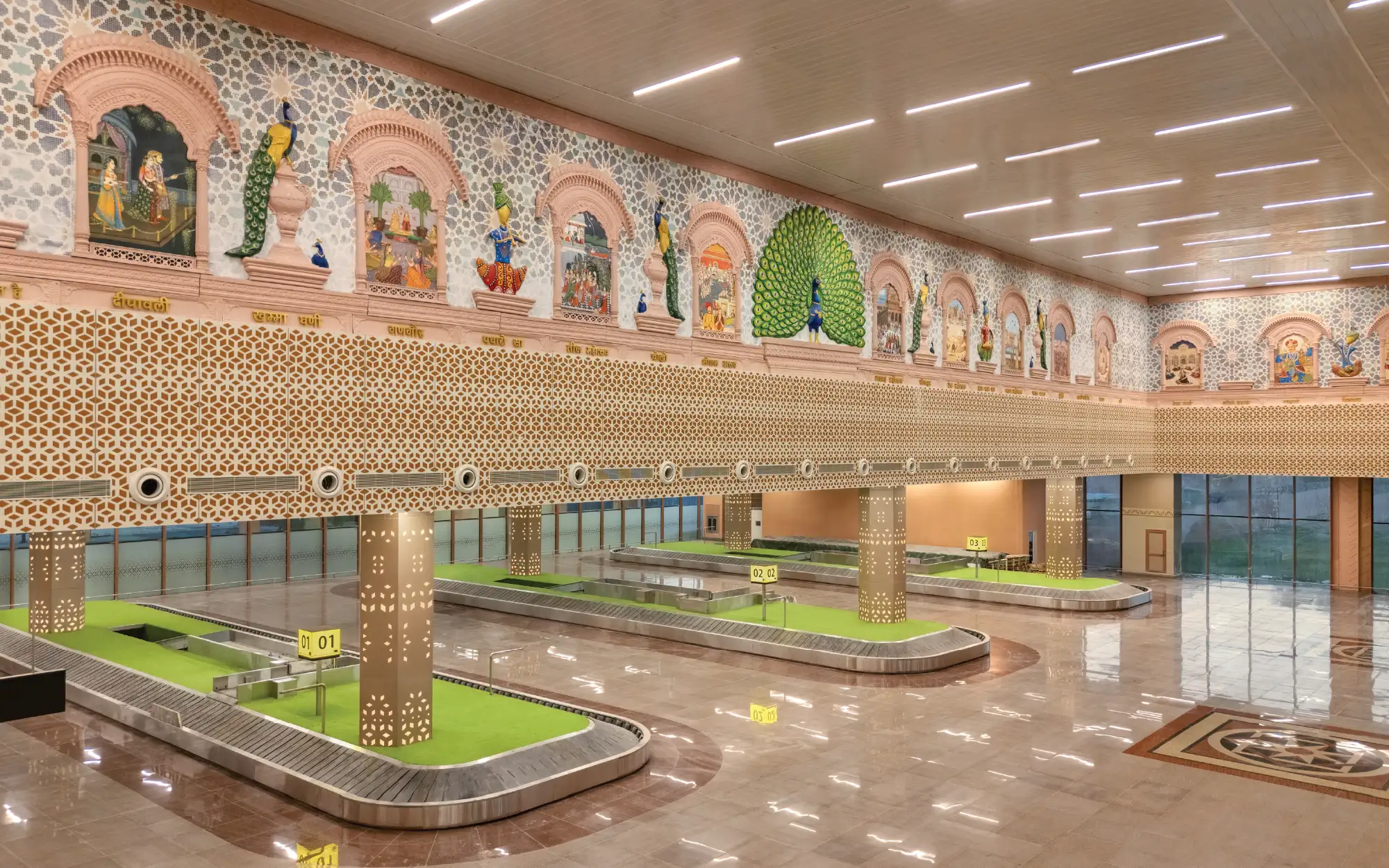
DP: The interiors feature murals crafted by craftsmen who draw on regional motifs. How did the collaboration come about?
KB: From the outset, we felt that the terminal should reflect not only Jodhpur’s architectural heritage but also its rich artistic traditions. Collaborating with artists became a natural
extension of this approach. Rather than treating art as an addition to the project, it was
integrated into the design process as an important layer of the passenger experience.
The artworks draw on the visual language of Marwar, including motifs, narratives, and
decorative traditions deeply rooted in the region. Working closely with the artists allowed us to translate these cultural references while respecting the authenticity of their craft.
DP: The project aims to achieve GRIHA certification through sustainability. What were the key design decisions or passive strategies that help achieve sustainability?
KB: Sustainability was considered from the earliest stages of planning rather than being introduced through individual technologies. The building responds to Jodhpur’s climate through orientation, a high-performance building envelope, shading strategies, optimised glazing ratios, and daylight planning that reduce heat gain and improve indoor comfort. Efficient HVAC systems, water conservation strategies, and groundwater recharge measures complement these passive measures. Together, they contribute to significant reductions in energy and water demand while supporting long-term operational performance.
DP: What materials were chosen specifically for their performance in Jodhpur’s harsh climate?
KB: Material selection was guided by durability, environmental performance, constructability, and long-term maintenance. GFRC became a key material for the façade because it combines lightweight construction with durability and allows intricate detailing through prefabricated elements. The material palette enhances thermal performance while responding to the region’s climatic conditions. Every material was evaluated not only for its appearance but also for its role in the building’s long-term performance.
Also Read: A Goldmine For Luxury Hospitality, With Avijit Singh
DP: How do you envision the terminal influencing hospitality, business, and cultural tourism in the future?
KB: Jodhpur holds a key position in one of India’s most-visited cultural corridors and in Rajasthan’s heritage tourism triad. Improved connectivity can strengthen tourism, encourage business travel, and enhance access to cultural destinations. When an airport reflects the character of the city it serves, it reinforces a destination’s identity from the very beginning of the journey.